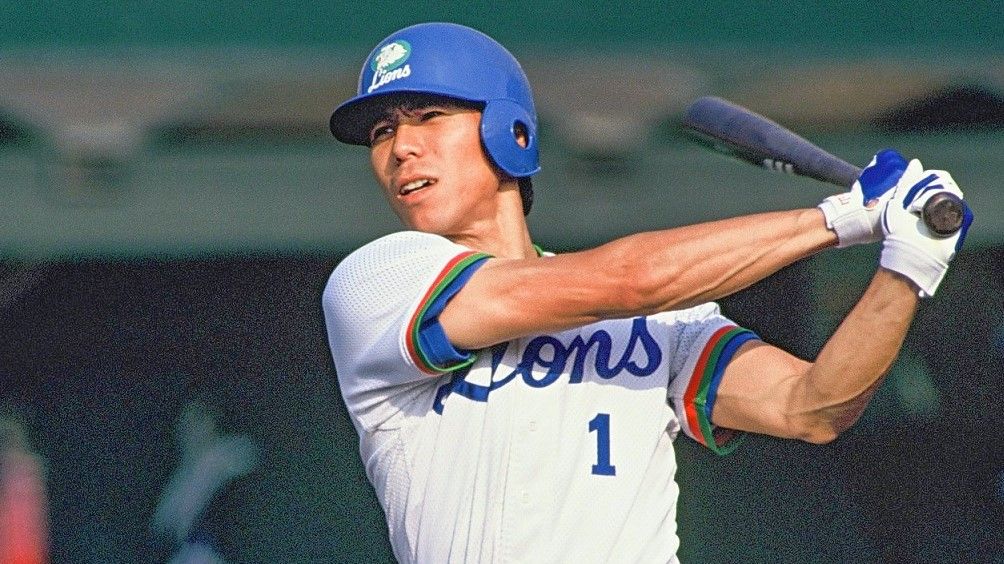
When it comes to power and home runs, 500 is the magic number in America. 28 different players have reached the milestone in major league history, from Eddie Murray to Harmon Killebrew to Barry Bonds. Eight players in Japan have reached the number, with Sadaharu Oh holding the world record at 868 round trippers.
In Japan, the magic home run number is 400. Professional baseball got a later start in Japan than in America, and schedules in NPB are shorter. Only 20 players have hit 400 or more in the history of Japanese baseball. Everybody knows Oh, but what about the players who sit behind him on the list?

Here are some facts about Koji Akiyama that shouldn’t all be true of one player. He went undrafted, and he finished with more home runs, hits, and stolen bases than any undrafted player in Japanese baseball history.
He hit more than 400 home runs and stole more than 300 bases, a combination only Isao Harimoto (the NPB hit king) had managed before him.
He set a new career record for strikeouts. He did backflips across home plate. The scout who signed him said he could have been an Olympic decathlete. He hit 30 or more home runs nine years in a row, a Pacific League record.
And the kid who became all that wanted to go to college instead of turning pro.
From Undrafted Pitcher to Slugger
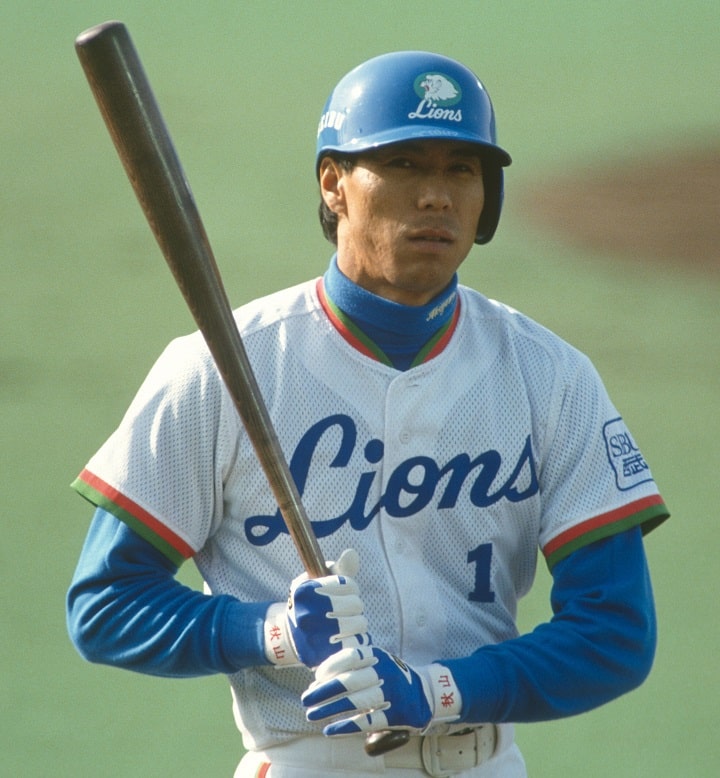
He grew up in Kumamoto, on the island of Kyushu, the son of a high jumper and a shot putter, a rather quaint combination. In high school, he was so tall that his coach said he had to be a pitcher, and he was good enough to get scouted by all 12 teams. Eleven saw an arm, but only the Seibu Lions saw a bat.
But Akiyama got accepted into Kyushu Sangyo University and intended to attend, so every team passed on him. Then after the draft, he changed his mind and announced he was turning pro. The Yomiuri Giants, the Hankyu Braves, and the Hiroshima Carp entered into a bidding war, but Seibu came out on top because they wanted to develop him as a hitter.
He was told by both scouts and manager Rikuo Nemoto that in four years, he’d be manning third base and batting cleanup for the Lions. Akiyama didn’t think he’d cut it, but he’d try it for a few years and, if it didn’t work out, head to college.
He made his debut on September 29, 1981, and hit his first triple. He appeared in two more games that season, and then Seibu hid Akiyama down on the farm.
Nemoto saw him as the heir to Koichi Tabuchi, the Lions’ big slugger, so the minors became somewhat of a science lab. There weren’t any bunting drills, nor practice hitting the ball the other way, just one lesson repeated over and over and over until it stuck: hit the ball over the fence.
The coaches argued about whether they were building a slugger or a contact man, but they somehow ended up with both. In 1982, he won the Eastern League home run title with 13 to go along with a .300 average.
Then Seibu sent him to America three times, to San Jose and the Arizona instructional league, where big-league people asked about signing him.
Akiyama didn’t play with the top team in either 1982 or 1983. In 1984, he hit his first home run early in the season, but injuries limited him to just 54 games, and he finished the season with only four home runs.
But then his training ramped up as he stepped in against a pitching machine that threw high inside fastballs over and over and over again. All the hard work paid off.
In 1985, he played in all 130 games and hit 40 home runs at the age of 23, tying Sadaharu Oh as the youngest ever to hit the mark. At one point in the season, he homered in five straight games. He followed up 1985 with 41, then 43, giving him three straight 40-homer seasons.
Backflips and Home Run Titles
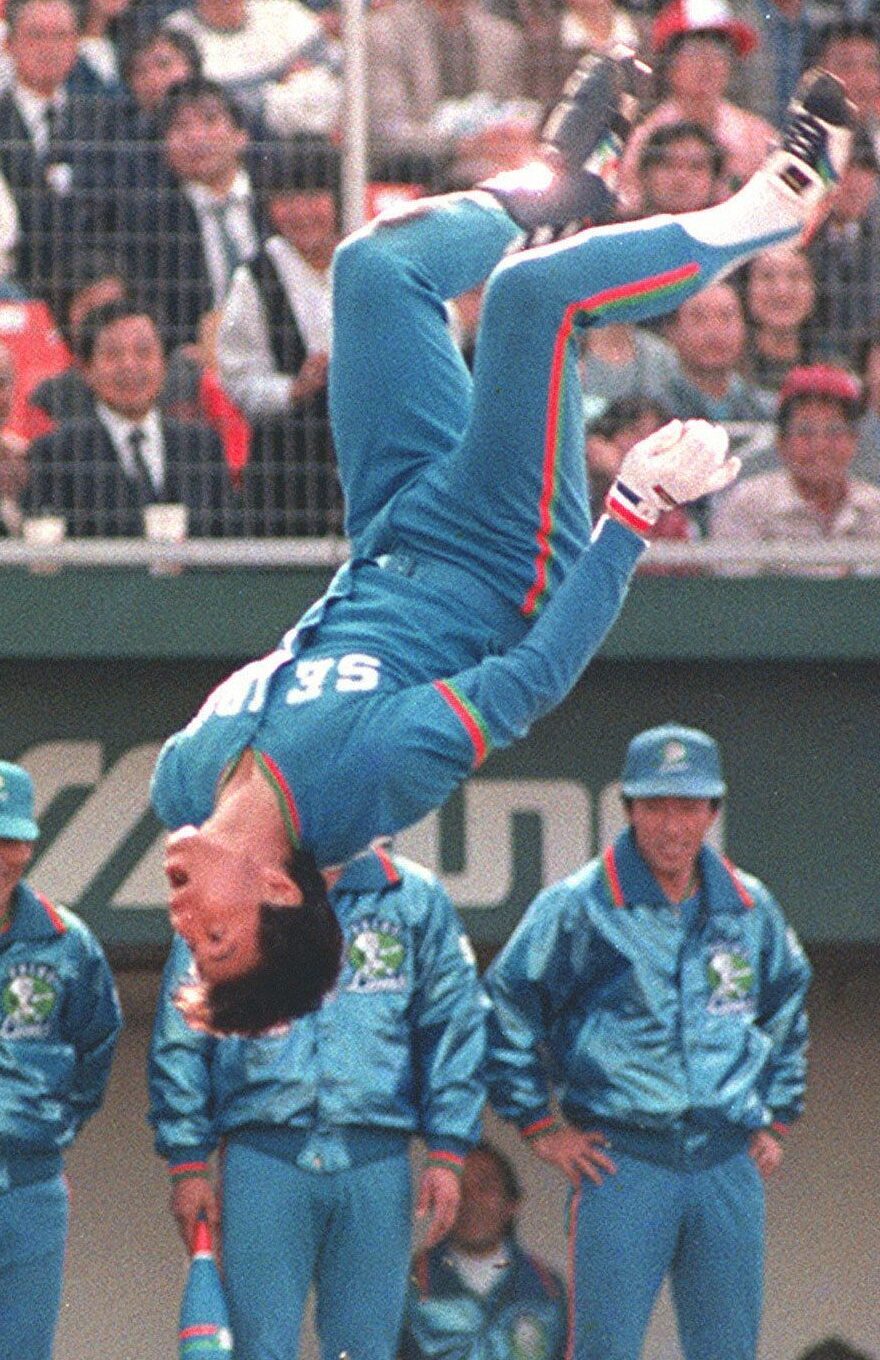
Which brings us to the backflip and the 1986 Japan Series between Seibu and Hiroshima, which was already strange: a tie, three straight Hiroshima wins, then three straight Seibu wins, forcing the first Game 8 in Japan Series history.
Akiyama had been awful, 5-for-30 at the dish, and manager Masaaki Mori had dropped him from third in the order to sixth. That was the sting.
He had just had his best season — .916 OPS, 41 homers, and 115 RBI, a career-high and one behind Hiromitsu Ochiai for the league lead — as Seibu’s cleanup hitter. In October, some teenage rookie named Kazuhiro Kiyohara took the cleanup spot, and Akiyama slid to third, forming the AK duo.
Akiyama had been planning to do something to shed his quiet image since the day before. Hiroshima led 2-0 after five. In the sixth, with one out and a man on, Akiyama swung at the first pitch and sent it to left for a game-tying two-run homer.
He asked the third-base coach if he could, then flipped, his feet landing a bit short of the plate, so he backed into home like it was a parking spot. Seibu went on to win the game and the series.
Akiyama did it again in the 1990 and 1991 Series, and the last time he landed on his ass and retired it. His antics even made ESPN’s SportsCenter, way back when it was relevant.
But the flip was just the garnish. The real meal was in the home runs.
From 1985 to 1993, he hit 30 or more in nine straight seasons: 40, 41, 43, 38, 31, 35, 35, 31, 30. Only Oh, with 19 in a row, has gone longer in NPB history.
In 1987, he moved to center field and hit 43 for his only home run title, reaching 100 career homers in 351 games, the fastest of any Japanese player, with 11 of them coming in May alone. Oh, and he also stole 38 bases that year, narrowly missing the 40-40 club.
In 1989, Major League castoff Orestes Destrade joined the lineup, and the AKD Trio was born, and Akiyama hit .301 with 31 homers and 31 swipes, the fifth triple-three (.300 AVG/30 HR/30 SB) in NPB history.
In 1990, it was 35 homers and 51 steals, the first 30-50 season ever, and the first time a former home run champion became the stolen base king.
In 1991, he hit four home runs in the Japan Series, drove in eight, and won MVP. In 1993, he hit grand slams on consecutive days, only the third time in NPB history anyone had done it.
He had speed, he had power, and he was a defensive wizard in the outfield (he won 11 Golden Gloves and led outfielders in range factor seven times in his career), but his bat had a hole in it, and it was a big one. He homered every 18.3 at-bats and struck out 1,712 times.
He passed Sachio Kinugasa for the all-time strikeout record on June 1, 2000, held it until Kiyohara took it in 2004, and now sits fifth, three behind Takeshi Yamasaki, who has his own entry in this series.
But Shigeo Nagashima called him a real home run hitter because of the arc of the ball off his bat, and what is a true home run hitter but someone who swings for the sky and misses a lot?
A New Home in Fukuoka

He was a star and helped the Lions win nine championships and ten pennants, but all good things come to an end.
On the night of November 15, 1993, Seibu’s general manager called and asked to meet the next day at noon. Akiyama canceled a round of golf, and the meeting lasted 15 minutes, during which he was informed of something shocking: he was being traded to the Daiei Hawks in a three-for-three deal.
Since free agency was new and he would soon be eligible, along with the fact that he was in his early 30s and he’d only hit .247 with a .198 average with runners in scoring position, Seibu thought it was time for a change. He’d been with Seibu for 13 years, since he finished high school.
Daiei was a last-place team run by Nemoto, the man who had signed Akiyama, and what they got was a player who changed the clubhouse culture. He was stunned at how little the players seemed to care about winning, with some goofing around in the locker room.
He didn’t give speeches. Munenori Kawasaki wrote that he barely spoke but was always at the ballpark, first to hit and last to go home. Hiroki Kokubo said he never made excuses for his failures.
Meanwhile, the Fukuoka Dome ate his power: 24 homers in 1994, then 21, then nine in 1996. But it didn’t stop him from being an impact player.
On June 16, 1998, he hit his 400th home run, a go-ahead two-run shot, becoming the 12th player to reach 400. The following season, his 300th steal made him the second member of the 400-300 club, after Harimoto.
In 1999, Daiei named him its first captain. On September 8, Daisuke Matsuzaka hit him in the face and broke his left cheekbone. He was back on the bench the next game, then in the lineup in a helmet with a face guard.
On September 25, in the game that clinched Daiei’s first pennant (and the first for the franchise since 1973), he led off with a home run.
In the Japan Series against Chunichi, he homered in Games 1 and 2, and in Game 3 he ran up the high right-field wall at the Nagoya Dome, made the catch, and threw out the runner at first.
He was named Series MVP, the oldest ever until Kokubo at 40 in 2011, and the first to win it for two different teams. What more could you ask from a captain?
A Lasting Legacy
On August 18, 2000, he got his 2,000th hit in his 2,000th game, a nice bit of symmetry. He retired in 2002, and at his retirement games, Hawks fans and Lions fans alternated his cheer songs, and each team threw him in the air. His last at-bat ended with a lineout to right.
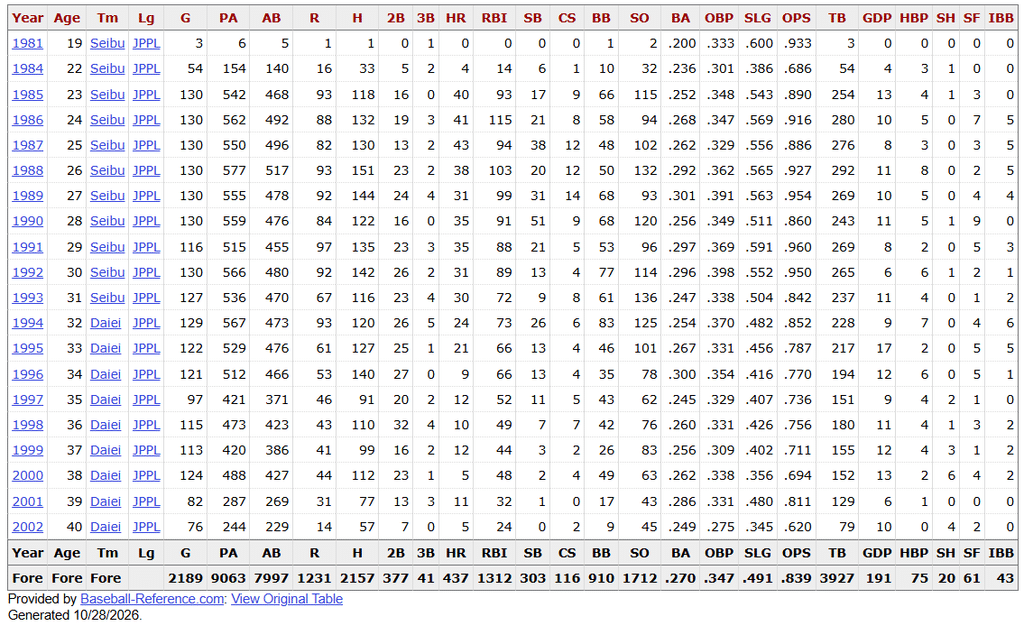
He ended his career with a line of .270/.351/.491, 2,157 hits, 437 home runs, 1,312 RBI, and 303 steals.
After retirement, he managed the Hawks to Japan Series titles in 2011 and 2014 and went into the Hall of Fame in 2014 with Hideo Nomo and Kazuhiro Sasaki, two players who had success in MLB.
Could Akiyama have had success overseas, too? We’ll never know, but his peers seemed to think so. Destrade said he could have started for any club in the big leagues. Kiyohara said he himself was a Japan-only player, but Akiyama would have made it. Ralph Bryant called him the best hitter he saw in Japan.
In the end, there was a kid from Kumamoto who wasn’t drafted, who was kept in the minors to learn one thing, and who learned it so well that nine straight 30-homer seasons are still the Pacific League record.
Eleven teams saw a pitcher. Thank God the Lions saw something else.
