To aficionados of Japanese baseball, the externals of Victor Starffin’s life and career – immigrant from Russia, first NPB pitcher to win 300 games, first foreigner to be elected to the Japanese Baseball Hall of Fame – are well known. But there is more that many – even his daughters – did not know.
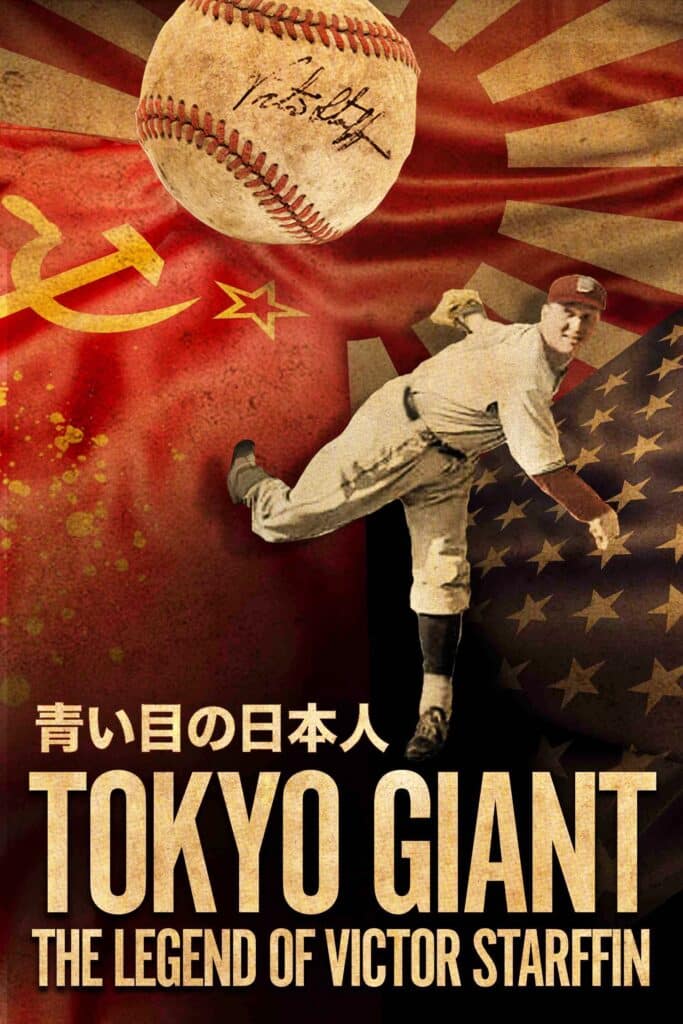
At least not until the last few years and the making of the documentary, “Tokyo Giant: The Legend of Victor Starffin”.
The Russian-produced film, which first premiered at the Moscow International Film Festival in 2022 and is currently available on Amazon Prime, delves into Starffin’s story primarily from the perspectives of his daughters, Natalia and Elizabeth. Both were very young when Starffin died in an automobile accident in 1957 at the age of 40 and had few memories of him. The documentary brings the two together as they try to find out more about their father.
“I wanted to find out who he was,” Elizabeth said in the film. “More about what kind of person he was, not what he did.”
Natalia added, “I thought maybe I could uncover the hidden parts of his life.”
The documentary reveals that the two had been separated for more than 40 years, since Elizabeth, at 14, was sent to the United States to continue her schooling. She now resides in Tucson, Arizona. Natalia remained in Japan. Though remaining a Japanese citizen, Elizabeth had not returned to Japan for 43 years prior to the making of the documentary.
The documentary makes clear that Starffin had a remarkable life of struggle and success.
He was born in 1916 in Nizhny Tagil, Russia, into a family the film describes as “wealthy.” His father, Konstantine, was an officer in the Czar’s forces. However, when the Russian Revolution happened the following year, the family had to escape to avoid execution. To do it, the father bribed the guards carrying the corpses of those killed. Hiding among frozen corpses, the family first went to Harbin in northern China and eventually came to Asahikawa on the Japanese island of Hokkaido. To pay the emigration fee to Japan, his mother sold some jewels she had hidden on her person.
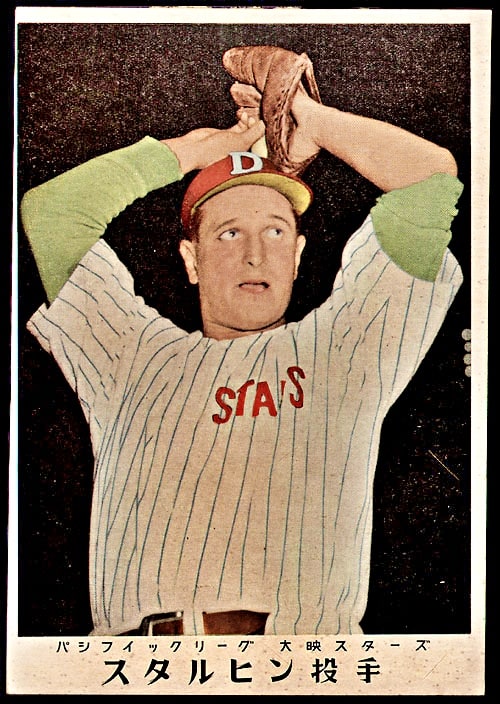
The family was poor, getting by on income from a bakery and a small startup business as a vendor of imported European fabrics. The story recounts how Starffin was often bullied and made fun of because he was a gaijin, or foreigner, and an unusually tall one at that (he eventually stood 6 feet 3 inches). However, he was diligent about learning Japanese and became more accepted when his athletic skills became clear. It has been written that he could win a 100-meter dash even when his classmates were given 20-meter head starts.
A friend from elementary school, Yasuyuki Takakawa, said in the film that “Starffin was a gaijin, so he was strange to the other children . . . there were a lot of morons in Asahikawa.”

Starffin’s daughters encountered similar issues when they were youngsters, 20 or so years later.
“They’d say ‘Yankee, go home. You don’t belong here,” Elizabeth said. “I’m sure it was because of [World War II]. As I got older, I’d say ‘I’m Japanese. I was born here.”
Added Natalia, “The more I felt I was Japanese, the more I had to face the fact that I was a foreigner. Because of that, I struggled a lot.”
Starffin soon picked up baseball and found that he was a natural on the mound with a good fastball. The documentary claims that, while in elementary school, he pitched against an adult team and won. Later, he wanted to play for the prestigious Koyo high school team, but the region’s other high school principals objected because he was a gaijin. Instead, he played for Asahikawa Higashi’s high school team, helping it twice reach the finals of the Hokkaido tournament of the Japanese High School Baseball Championship.
He was 18 when the Babe Ruth-led American all-star team came to Japan following the 1934 season to play a series of games against the All-Nippon team formed by Matsutaro Shoriki that later became today’s Tokyo Yomiuri Giants. He wanted Starffin on the team, but the youngster demurred. At the time, the Japanese considered playing for money to be sordid, as opposed to the “pure” amateur game, and Starffin did not want to jeopardize his amateur standing.
However, Shoriki, owner of the powerful Yomiuri Shimbun newspaper, discovered that Starffin’s father was facing charges related to the killing of a co-worker, said in the film to have been his lover. Shoriki then effectively blackmailed the young pitcher, saying that if Starffin did not play for the All-Nippon team, he would expose the father’s situation. Had that happened, the family members could have been deported to Russia, where they would have almost certainly been executed.
Thus, Starffin pitched against the Americans, who were taken aback when they saw the tall Caucasian playing for the Japanese side. The film states that Starffin first walked Ruth, though multiple written reports say it was Lou Gehrig, before striking out Jimmie Foxx, walking Earl Averill, and inducing Bing Miller to hit into a double play. It was his only appearance of the exhibition series, but he was with the team when it traveled to the United States the following year for a set of exhibition games, though he was initially not allowed to leave the ship because he held neither Russian nor Japanese citizenship. American teams, we’re told in the film, were interested in him, but he chose to remain in Japan.
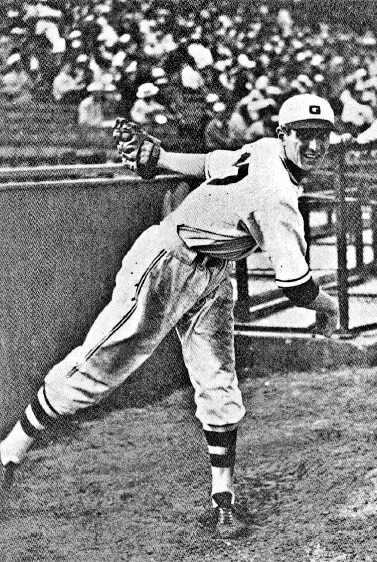

He continued playing with Yomiuri from the beginning of the Japanese professional league in 1936 through 1944, winning 199 games against just 66 losses. He posted a remarkable 42-15 record with a 1.73 earned-run average in 1939 and followed that with a 38-12 mark and a hard-to-believe 0.97 ERA the next season. He pitched an otherworldly 894 innings in those two campaigns – today, 200 in a season is considered a lot – and was voted the league’s Most Valuable Player both years.
Despite his stardom, though, he faced struggles. Though he loved Japan and became fluent in the language, he was never granted Japanese citizenship. In effect, he was stateless.
Also, as the relationship between Japan and Russia deteriorated and Japan and the world headed toward war, the film reveals that Western words – even those such as “strike” and “ball” – were banned in favor of the Japanese equivalents, and Starffin had to change his name to “Hiroshi Suda.” Natalia notes wryly that “Victor Starffin” was the league MVP in 1939 and that “Hiroshi Suda” earned the honor in 1940.
Starffin continued to play until 1944 when the Japanese moved all foreigners into detention camps – essentially house arrest, as they had to get permission to leave the house for anything. He had, from the late 1930s, been under constant surveillance as an untrustworthy outsider and perhaps even a dangerous foreign agent.
“He was accused of being a spy,” Natalia confirmed.
After Japan’s surrender, Starffin worked briefly as an interpreter for the American occupation forces. He returned to baseball in 1946, but, according to the documentary, was not re-signed by the Giants, with no reason given. He had a 104-110 record during the last half of his career, finishing with a 7-21 mark for the Takahashi/Tombow Unions (a precursor of today’s Chiba Lotte Marines) in 1955. He got his 300th career victory on Sept. 9, 1955, against his former Daiei Stars team. At age 38, he wanted to continue pitching, the film tells us, but he was released and not signed by another team, even though he said he would pitch for free.
Overall, he finished with a 303-176 record, a remarkable 2.09 ERA, and a very low 1.067 WHIP. His 83 career shutouts are still the Japanese record. Though he was said to have a great fastball – 400-game winner Masaichi Kaneda estimates that it was around 160 kph, or 98.7 mph – he averaged only 4.2 strikeouts per nine innings over the course of his career. Rather than overpowering batters with his fastball, he was a master at inducing weak contact from the batters.

After leaving baseball, he did some acting and also hosted a radio program. He tried to get into baseball in some capacity but was unable to, and the film compares his frustration to that of Ruth, whose hopes of becoming a manager never came to fruition.
“He often told people that baseball had betrayed him,” daughter Natalia said.
He was killed less than two years after retirement when the car he was driving collided with a streetcar in January 1957. According to the film, he had been drinking beforehand, the implication being that this contributed to the accident.
At the funeral, the daughters had a hard time understanding what had happened. “I asked mom over and over, ‘Why is dad sleeping?’” Elizabeth said. “I couldn’t process that he was gone.”
The mother, Kunie, eventually remarried to a Japanese man whose business later went bankrupt. At some point after that, she “took her own life,” Natalia said.
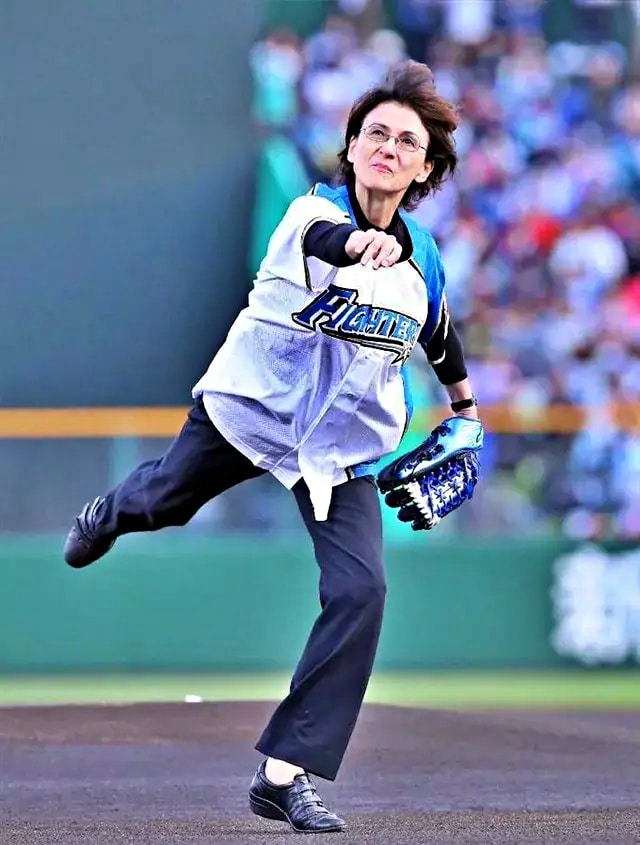
Toward the end of the film, Elizabeth visits Starffin’s birthplace in Russia and throws the ceremonial first pitch before a Russian baseball federation game. It also mentions that when the city of Asahikawa opened a new baseball stadium, it named it after Starffin.
Overall, the documentary gets a positive mark from the writer. Telling Starffin’s story through the daughters’ perspectives and their shared quest to learn more provides a unique angle. But some things are missing that would flesh out his story.
Nothing is said about why Elizabeth had been away from Japan for so long, and one wonders if the sisters had much contact in the interim. It only shows Elizabeth saying she went to the U.S. because her mother could no longer afford private schooling in Japan. Perhaps this was done to keep the film’s focus on Starffin, but it would have been interesting to know more about the daughters’ histories.
Also, the film discusses how Starffin and the mother, Kunie, met, but it makes no mention of his first marriage. Starffin had wed a Russian emigrant, Elena, in 1939, and son George was born in 1941. Elena later filed for divorce and left for the United States, leaving a seven-year-old George in Japan with Starffin. The documentary mentions nothing about Starffin’s first marriage or his son and what became of him.
In addition, Starffin reportedly had had a “long-developing alcohol-abuse problem” and had also incurred significant episodes of paranoia that his father had also suffered from. The film barely touches on the former – saying only that his wife urged him not to drive on the night of his passing because he’d been drinking – and it doesn’t mention the latter at all. And while his death is officially considered a tragic accident, there are others who thought that it was actually a case of suicide.
However, the documentary is interesting and worth watching for anyone interested in the history of Japanese baseball.
For more about Victor Starffin:
- Stream the film
- https://sabr.org/bioproj/person/victor-starffin/
- https://en.wikipedia.org/wiki/Victor_Starffin
- https://www.baseball-reference.com/register/player.fcgi?id=starfi000vic
- https://www.youtube.com/watch?v=OGXCtKXGo20
- https://www.youtube.com/watch?v=I_r29biPk6k
- https://www.youtube.com/watch?v=NsoRbeLAL7o