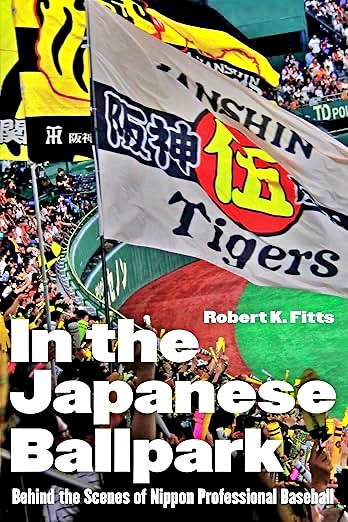
Of the many books written about baseball – more than 70,000 by one estimate – stories about individual players, managers, teams, and specific games perhaps form the majority of the titles. The new offering from Rob Fitts, however, is an outlier.
Fitts, author of 11 books about Japanese baseball, has penned In the Japanese Ballpark, which takes a look at the Japanese game from the perspectives of 26 people who have been or are still involved. The list includes just two players and two managers, while highlighting the likes of a former umpire, a sportswriter, a super fan, a “beer girl,” a former league commissioner, a minor league player, and others. The result is a deeper, more nuanced view of baseball in Japan than one would normally get.
Fitts writes that he began to realize how little he knew about what happened “off the diamond” at a baseball game, so he turned “to the true experts, the people who play, oversee, promote, and watch the game . . . to provide a behind-the-scenes look.” The goal was to reveal some of the inner workings and explain the cultural aspects that make Nippon Professional Baseball (NPB) different from Major League Baseball (MLB).
He purposely interviewed roughly the same number of Japanese and foreigners, as the latter are better able to recognize differences between NPB and MLB and are “often able to see cultural differences and practices that native Japanese take for granted.” Japanese, however, have a “greater understanding of the subtleties of their own culture and often have different explanations for behavior that perplexes foreigners.”

The work wasn’t as simple as one might think because the process of obtaining interviews in Japan is much more restrictive than in the United States, where, in most cases, a writer can reach out directly to a player, manager, or other employee. In Japan, most teams control access to players and employees. One team did not allow any of its employees to speak to Fitts, and several others wanted to see a list of questions beforehand and the right to review and edit the text. This was time-consuming and sometimes resulted in significant changes to the narratives.
Nonetheless, the book is replete with interesting anecdotes, detail, and background information that the average fan would not be aware of. The book opens with an overview by Robert Whiting, the award-winning journalist who has lived in Japan most of his life and written extensively about Japanese baseball. It then continues with sections for those who have been involved “On the Diamond”, “In the Ballpark”, “In the Clubhouse”, “In the Front Office”, and in “The Business of Baseball”, with a conclusion focusing on two-time Chiba Lotte Marines manager Bobby Valentine.
Each chapter is told in the first person, as if the interviewee was communicating directly with the reader. Fitts says he began the interviews with prepared questions but encouraged the people to bring up any topics they felt were important to understand the Japanese game. He says these often resulted in unexpected stories and insights. Here are just a few examples:
Keiko Suzuki, was a uriko for two years at Koshien Stadium, home of the Hanshin Tigers. The uriko – known colloquially as “beer girls” – sell alcoholic drinks to fans in the stands, and those who have never observed them work don’t realize how hard the job is. Carrying either heavy beer kegs on their backs or trays of cocktail drinks around their necks, they double-time it up and down the stadium steps, all the while smiling to each customer. It’s also very competitive, as the women vie to be top sellers.
“I probably lost between 11 and 17 pounds since starting the job,” Suzuki said. “At night, after the games, my face usually hurt from smiling – from keeping my muscles in that same position [during the] game.”

Matt Murton, the former MLB player who averaged .311 in six seasons with the Hanshin Tigers, recalled the vast array of items for sale in the team shop, much of which contained the players’ names or photos – “Key chains, towels, stickers, everything. They even had a meal at the ballpark named after us. The Murton included katsudon, tamago, and katame. They leave no stone unturned when it comes to the marketing of memorabilia.”
Natsuo Yamazaki umpired in 1,451 NPB games from 1988 until 2010. In one 1991 contest, manager Masaichi Kaneda of the Lotte Orions (now the Chiba Lotte Marines) called him an idiot. Yamazaki replied, ‘I’m not as big an idiot as you are’ and ejected him. The next day, as the managers were exchanging lineups prior to the game, Kaneda approached Yamazaki and said, “I realized, sir, that you graduated from university, so you’re not an idiot, and I’m sorry that I called you one. What I should have said is ‘You suck!’”

Jim Allen is an American with more than 30 years as a journalist covering baseball in Japan. He talks about the restraints facing Japanese media that do not exist in the U.S. For example, the regional and national newspapers don’t allow reporters to write about things people do that may be inappropriate but not illegal.
He also tells of the time he tweeted about the Yomiuri Giants planning to post a player to MLB, which was a first for the club. The team complained vociferously, even though it was true. Allen did not know that the Japanese media had been sitting on the story because of conditions placed by the player and his agent, and his employer, Kyodo News, “descended on me like a ton of bricks.”
“There’s the difference between Japanese and American media laws. In the U.S., if I write a tweet, it’s considered a tweet by a guy who happens to work for Kyodo News. But in Japan, the tweet is legally considered a Kyodo News story. That mistake cost me hundreds and hundreds of dollars in lost pay and pay increases over the next four years.”
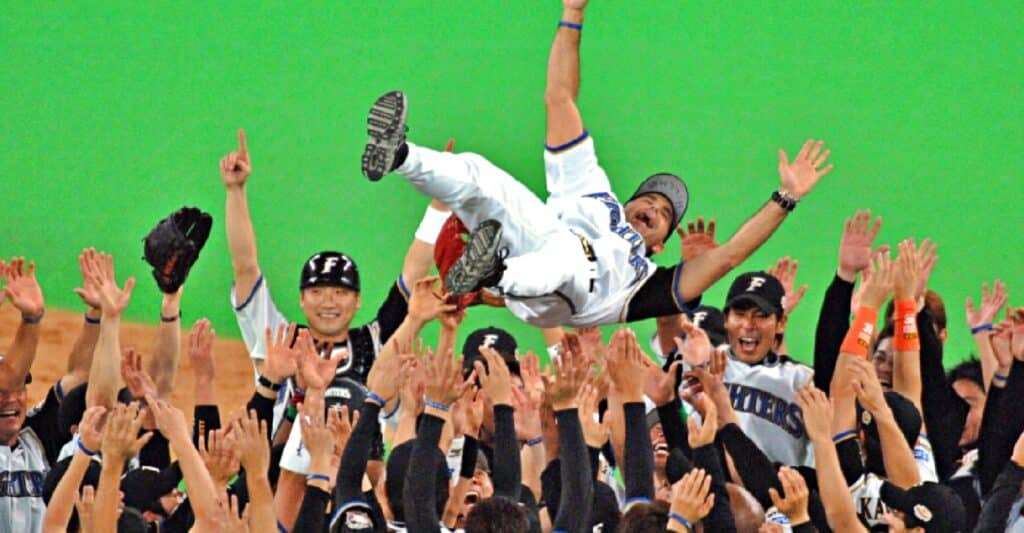
Former MLB manager Trey Hillman won an NPB title with the Nippon Ham Fighters, but at first faced the inevitable adjustments any foreigner does. “The amount of preparation [on the parts of the Japanese] . . . I joke about this all the time, but it’s not a joke. We would have meetings to decide when the next meeting was. I had to get used to that part of the culture . . . [to] stop rolling my eyes and going ‘Are you serious?’”
Hillman tried to shorten the practices in his first season, but his shortstop did something unusual for a Japanese player – he went to the manager and asked to talk freely. He told Hillman the players appreciated what he was trying to do, but if “we don’t have a certain number of swings, or a certain amount of ground balls, or a certain amount of time on the clock, then our spirit doesn’t rest well at night. Then we’re not getting good rest.” So Hillman expanded the practice times.
Jennie Roloff Rothman is an American who has taught in Japan since 2004 and become a superfan of the Yokohama DeNA BayStars. “I really love the hamster mascot. It’s so ridiculous. Oh, the vicious hamster! Baseball and a hamster. Are you kidding me?”
She and her husband have three carry-on-sized suitcases full of team uniforms – one for the Bay Stars, one for the Marines – her husband’s favorite, and one for Samurai Japan.
“I always have my BayStars keychains and things on my backpack. When I go to games – it’s a 90-minute train ride – I will wear my BayStars uniform all the way through Tokyo just to show I’m part of this community. There have been times coming back from Yokohama that I’ve been on public transportation for an hour and a half and still wearing my hamster ears! I’m okay with it, but, at the same time, I know this is a new level of ridiculous.”
Shungo Fukunaga spent four years in the Hanshin Tigers organization, playing mostly with the farm team, and has also played in Taiwan, Mexico, and the Japanese independent leagues. He said the clubhouses in Japan and Taiwan are very quiet before games, but it was very different in Mexico.
“It was culture shock. There was loud music – really loud music. A player might put on a virtual reality headset and play a game. People would be screwing around and just messing with each other. Some guys would have Segways, and they would be zooming around the locker room on them. I would say it’s pretty close to zero horsing around like that in a Japanese locker room.”
Kenjiro Kajita pitched collegiately for Grinnell College in Iowa, has interned with the Yomiuri Giants, and has worked as a security guard at Meiji Jingu Stadium, home of the Yakult Swallows. The Swallows fans, he says, “are kind of relaxed and just there to enjoy the game. But the Hanshin Tigers fans, or any sort of fans from western Japan, are really rowdy, and they’ll start yelling a lot. That’s when it’s no longer fun to be standing there watching baseball.
“If something happened among the fans, like a scuffle, we had to go and intervene. But we were high school and college students, while they were full-grown adults and not in the mood to listen to us. We usually had to get our supervisors to tell them off. That was one of the most nerve-wracking experiences, and it actually happened quite often.”

Ryozo Kato, formerly the Japanese ambassador to the United States, was NPB commissioner from 2008 until 2013. He says the commissioner does not have much power and has a salary “about one-fifteenth” that of MLB’s commissioner.
“The commissioner’s office deals with lots of complaints from teams that the umpires are not so good, and scandals, because the owners don’t want to get involved, such as the yakuza and drugs. Dealing with the yakuza was one of the few things that was successfully accomplished, mainly with the help of the Yomiuri Giants. The yakuza would buy all the tickets and sell them at higher prices. The kids would stand in line for tickets, but they would all be sold out. With the help of the police, we could identify who these guys were and not sell to them. These days, you don’t see many yakuza around.”
Ken Iwamoto was an interpreter for the New York Mets and has been with the Nippon Ham Fighters since 2003. He says that he found the job more difficult when he translated for Tsuyoshi Shinjo in New York because he was going from his native Japanese language to English, rather than from English to Japanese. “As an interpreter in New York, you can’t make a mistake. Pressure-wise, being an interpreter in the United States was tougher.
“With Shinjo, the most important thing was knowing what he really wanted to say, not the direct meaning.” After one game in which Shinjo had faced the Korean pitcher Chan Ho Park, he answered ‘I don’t know him’ to a reporter’s question. “He should have known about him because they had played against each other, and Park had played in the United States for many years. So I translated it as ‘You know, it was the first time for me to face Chan Ho Park.’”

The late Marty Kuehnert first came to Japan as an exchange student while at Stanford University. He later spent many years in Japan and was the first foreigner to be general manager of an NPB team, the Rakuten Golden Eagles. He recalled the extreme focus the Japanese media has on the players.
Kuehnert told the story of when eventual star pitcher Daisuke Matsuzaka was just 18 and lost his driving license for speeding. Yet he drove a car owned by the Seibu Lions to his girlfriend’s house and received a ticket for parking illegally. The team’s PR director told the police that he’d driven the car, but a reporter had been there taking photos, so “it became a huge scandal. The PR person and the president of the club resigned, and Matsuzaka lost 10 commercials worth about $10 million.”
The book contains many more insights and anecdotes like these, and Fitts ends the book with some helpful appendices containing tips on following NPB from outside Japan, collecting Japanese baseball cards and memorabilia, and attending games in Japan. Last is a list of recommended English-language books about NPB.
All in all, the book is one that even the casual fan will find interesting.