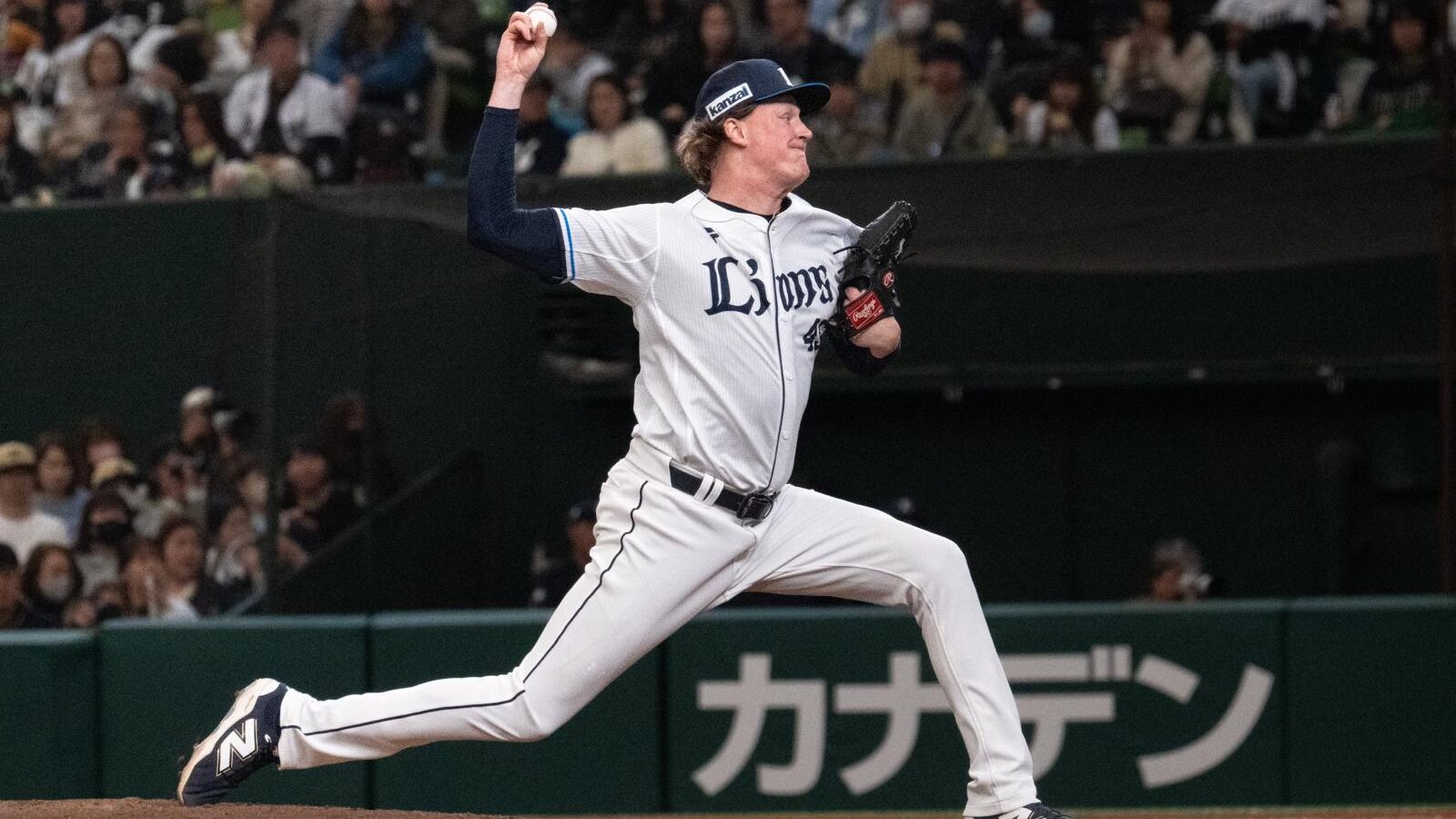
Only one pitcher in Nippon Professional Baseball is striking out over 40% of the batters he faces this season. Taisei? Raidel Martinez? Shinya Matsuyama? Kazuki Sugiyama? Good guesses, but wrong. It’s Trey Wingenter.
The Alabama native has come a long way from home and taken Japan by storm, obliterating hitters out of the Saitama Seibu Lions pen with a staggering 40.5% strikeout rate over 32 appearances. “I’m loving it so far. My wife and I are having a great time. Feeling healthy. Hard to complain,” he tells me.


“The atmosphere is awesome. The fans clearly care and are into every game. I love the Lions’ home crowd. And the way the Belluna Dome is structured, it’s arguably the loudest stadium in the league,” he adds.
The 6-foot-7 right-hander was drafted by the San Diego Padres in the 17th round of the 2015 MLB Draft out of Auburn. He made his big league debut in 2018 and appeared in a career-high 51 games for San Diego the following year.
“Craig Stammen and Kirby Yates really impacted me when I first made it to the big leagues with the Padres,” he recalls. “They were the main veterans in the bullpen when I was a rookie. Two guys who were ultimate pros. They gave me a lot of advice and helped shape my view on all aspects of pitching at the highest level. Sequencing, managing workload, mentality, execution, and even off-the-field stuff. Two different but equally positive influences on my career.”

Tommy John surgery sidelined Wingenter for almost all of 2020 and 2021. After that, he bounced between the Reds, Tigers, Red Sox, and Cubs organizations, seeing limited action at the MLB level. He registered 127 punchouts across 97 career games in the show. But when the Cubs non-tendered him on November 22, 2024, he was left without a team. Then the Seibu Lions came calling.

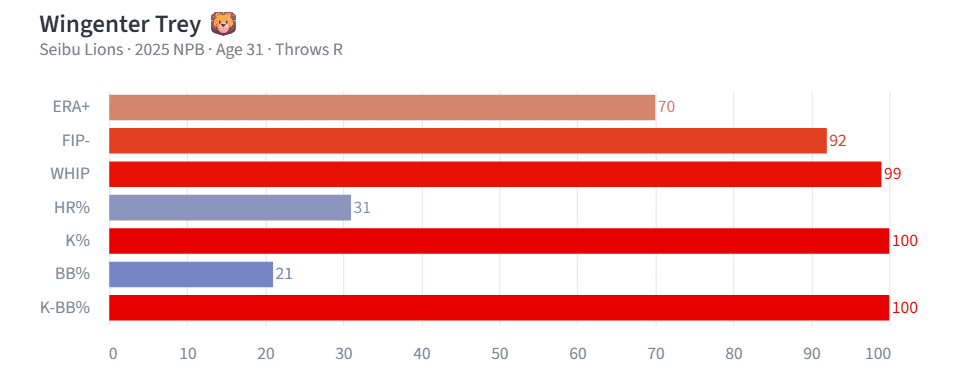
The 31-year-old quickly turned heads in spring training, fanning 10 batters over six innings with just one run allowed. He’s carried that momentum straight into the regular season, posting an impressive 1.80 ERA, 0.70 WHIP, and 21 holds. Wingenter leads all NPB pitchers with at least 30 innings in both strikeout-minus-walk rate (32.4%) and whiff rate (39.1%). He’s recorded at least one punchout in 28 of his 32 outings.
“The biggest key for strikeouts is always getting ahead in the count. You can strike guys out without getting ahead, but life gets a lot easier when you do,” he says. Wingenter also credits Seibu’s staff for his success: “Our scouting department does a great job of giving us the data we need. I use some of that to figure out an attack plan on the opposing hitters and what to throw on the first pitch, possibly what to use with two strikes.”
“Trey is a relentless worker who has overcome a plethora of injuries,” notes Tyler Zombro, Chicago Cubs Special Assistant Pitching Coach and Tread Athletics Performance Specialist, who trained Wingenter following the 2023 season. “He’s reestablished his velocity floor while also refining his slider shape and adding a kick-change. It is not often you find someone with over four years of service time who has the motivation and work ethic to redefine themselves at age 31, but Trey is doing that.”

To this point, Wingenter’s pitch mix consists of 57.6% four-seam fastballs, 38.9% sliders, and 3.5% changeups. His average fastball velocity of 96.3 mph ranks among the top five in NPB, and he’s touched 100 mph, the fastest pitch ever recorded at the Belluna Dome. His go-to putaway weapon is a slider with a 58% whiff rate, the highest of any pitch in the league. Opponents are hitting just .163 against his heater and a microscopic .068 against his slider.


(graphic by @bacc_prop on X)
“I spend a lot of time fine-tuning my delivery and mechanics because, as a taller guy, there’s more room for things to go wrong, which leads to losing command of the ball,” he explains. “It’s something I’ve battled my whole career. But when I’m attacking the zone confidently, and when I have my fastball and slider appearing the same to hitters out of my hand, I believe that makes it tough on them. I try to make it to where the hitter has to respect both pitches in any count, all the time.”
If the flamethrower ever needs help or wants to talk ball, he has talented teammates in the bullpen to lean on. “Kaima Taira and I think similarly when it comes to pitching. We’ve had lots of talks about delivery, sequencing, and things like that,” he shares.

“Hiroshi Kaino and I have talked a lot about routine, recovery, and managing and preventing injury. Shinnosuke Hada and I have talked about our struggles at times with command, as bigger guys with good velocity, and how to better attack the zone, get ahead of hitters, and simplify our mentality. Letting our stuff work for us.”
Taira, Kaino, Hada, and Wingenter form a formidable bullpen core, each averaging over 95 mph on their fastballs and featuring distinct secondary pitches. Together, they’ve combined for 44 holds and 21 saves this season, helping keep the Lions competitive in a tough Pacific League.

Regarding the differences between American and Japanese baseball, Wingenter says, “There are some distinct styles of hitters in NPB. There are hitters who are similar to the American style, looking to hit doubles and home runs every at-bat, and are okay with some swing-and-miss and strikeouts being a consequence. But there are three or four hitters per lineup with a different approach. Not scared to foul balls off or simply put it in play and use their speed to their advantage. They’re also not afraid to bunt.”
“Then there are hitters who can do a lot of damage, but also aren’t scared to shorten up with two strikes and try to cause some chaos. The challenge for me has been to try to determine the approach of each individual hitter and what they’re aiming to accomplish, and figuring out how to counter it,” he continues.

So, who has stood out to him the most? Wingenter named several players from each PL team he’s been particularly impressed by, including Ryo Ohta and Ryoma Nishikawa of the Orix Buffaloes; Itsuki Murabayashi and Hideto Asamura of the Rakuten Eagles; Chusei Mannami and his former Padres teammate Franmil Reyes of the Nippon-Ham Fighters; Hotaka Yamakawa and Ukyo Shuto of the SoftBank Hawks; and Yudai Fujioka of the Lotte Marines.
Though there was an adjustment period, Wingenter is now enjoying many aspects of life in Japan, both on and off the field. “Love the ball. The leather is much easier to grip. No need to be rubbed up, they’re ready right out of the package,” he says of the NPB ball, which is slightly softer, has higher seams, and comes pre-tacked compared to its MLB counterpart.

When asked about his favorite stadium outside of his home park, he answered, “The coolest is probably Es Con Field. I love the trips to Sapporo.” Beyond baseball, some of his favorite parts of Japan include the food and golfing.
“I’ve loved my experience with Japanese food,” he says. “The steak is arguably the best in the world. My wife and I have enjoyed trying new restaurants as often as possible. I’ve also enjoyed playing golf when I’ve gotten the opportunity. Golf culture is huge in Japan. I love the four-man golf carts and the full lunch between the front and back nines.”
Wingenter is proving that he’s in the right environment, emerging as one of the most overpowering arms in NPB by blending raw stuff with dedication and an analytical approach. Everything he’s worked toward is showing up with his dominance on the mound.
Note: This interview was conducted on July 18, 2025.
