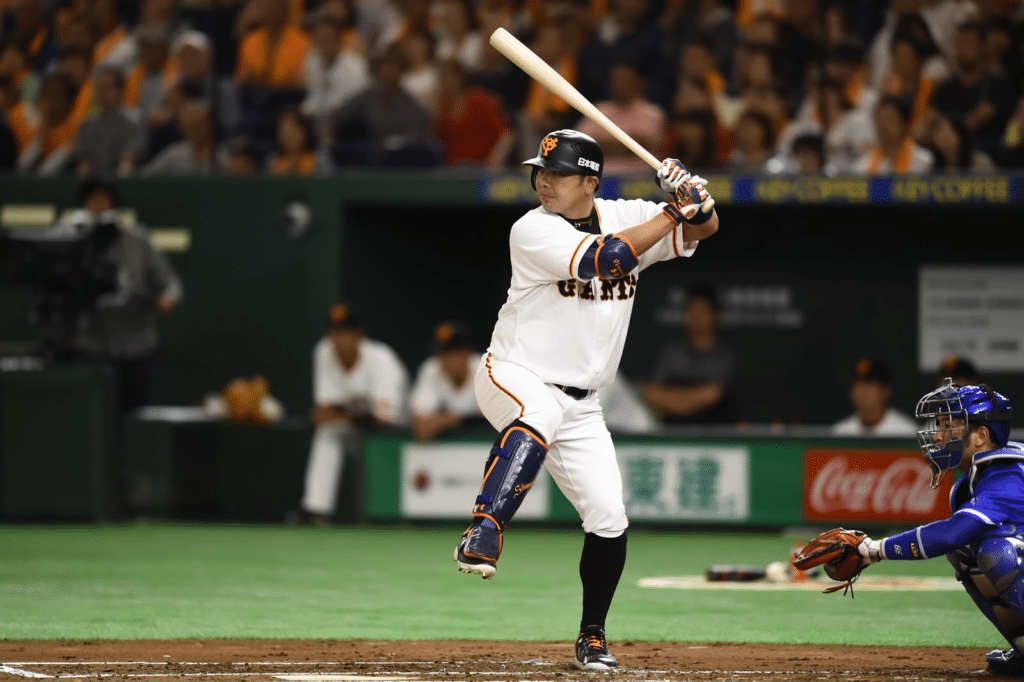
When it comes to power and home runs, 500 is the magic number in America. 28 different players have reached the milestone in major league history, from Eddie Murray to Harmon Killebrew to Barry Bonds. Eight players in Japan have reached the number, with Sadaharu Oh holding the world record at 868 round trippers.
In Japan, the magic home run number is 400. Professional baseball got a later start in Japan than in America, and schedules in NPB are shorter. Only 20 players have hit 400 or more in the history of Japanese baseball. Everybody knows Oh, but what about the players who sit behind him on the list?
A Club of Two
Shinnosuke Abe hit 406 home runs in his career, but that’s not the number I want to focus on. The more impressive number is two. Yes, two.
That’s how many players in the history of Nippon Professional Baseball have caught at least 1,000 games, collected at least 2,000 hits, and hit at least 400 home runs*. One of them is Katsuya Nomura, one of the greatest catchers who ever lived, and who spent the back half of his career as a walking baseball encyclopedia disguised as a broadcaster in between stints in the dugout. The other is Shinnosuke Abe.
*Only one person has done it in MLB: Mike Piazza.
That’s the whole list — just two names. Baseball has been played professionally in Japan since 1936, and through all those decades, only Nomura and Abe managed to do the two hardest things in the sport — catch a pitching staff for a decade and a half and keep hitting bombs.

The story often told about Abe is that he became a left-handed hitter because his father had been high school teammates with future Hanshin legend Masayuki Kakefu — third in the order to his father’s cleanup spot* — and young Shinnosuke wanted to swing the bat the way his hero did.
That part is true. But it isn’t, according to Abe’s father, the actual reason: Abe developed poor vision in his right eye early on in his grade school years, and his father had him start hitting from the left side because of it.
The Kakefu worship was real, but his swing was more built around a bad eye before it was built around an idol. As a former glasses wearer, that’s a better story anyway.
*Fun fact: while the cleanup designation is reserved for the fourth batter in the English-speaking world, it covers the third, fourth, and fifth batters in the Japanese baseball world.
The Making of a Slugger
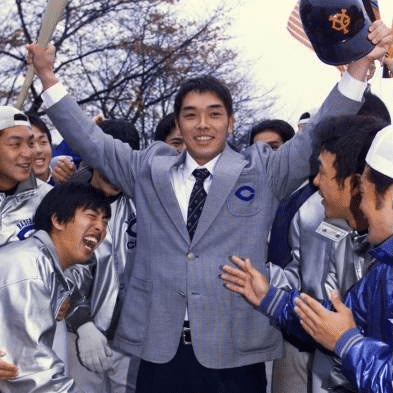
Abe was good enough as an amateur that Chunichi’s scouts wanted him before he’d even finished high school and planned to draft him in the third round, until word got out he was headed to university instead.
The Giants drafted him in the first round in 2000, and by the time the 2001 season rolled around, he was starting behind the plate on Opening Day — the first rookie catcher to do that for Yomiuri in twenty-three years. He hit for a rather paltry batting average that year, but from the eighth spot in the order, as a 22-year-old, he hit 13 home runs. Only one rookie catcher in NPB history had ever hit double-digit homers before him: Koichi Tabuchi, number 12 on this list.
For what Abe’s power actually looked like at its most explosive, you have to go to April 2004.
He hit his first homer of the season in the Giants’ seventh game, and then he didn’t stop. He strung together six home runs in six consecutive games, one shy of the NPB record.
On April 28th, against Yakult, he hit three home runs in a single game.
By the end of the month, he had 16 home runs in April alone — tying the all-time NPB record for homers in a calendar month*, a mark shared with Hiromitsu Kadota (1981) and Akira Eto (1994), and breaking Sadaharu Oh’s own team record.
On May 12th, against Hanshin, he hit his 20th home run of the season in his team’s 33rd game, becoming the fastest to 20 in Japanese professional baseball history, faster than Alex Cabrera had done it in 2001. Barry Bonds only had 14 through the other Giants’ first 33 games when he hit 73. Newspapers ran pieces speculating that if he kept it up, he might finish with 90.
*Since surpassed by Wladimir Balentien, who hit 18 in August of 2013.
Of course, there’s no way he was going to finish with 90. He finished with a very good 33, eighth in the league, after his pace cooled by the summer.
What’s a little more interesting than the power outage is how Abe responded when reporters asked him about the onslaught while it was happening. He kept giving them nothing for answers, things like he wasn’t thinking about it or he wasn’t trying to do too much with the bat. He wasn’t being modest so much as actively voicing his disinterest in the storyline.
His bat was drawing comparisons to Hideki Matsui, while his glove was often criticized — despite having won a Golden Glove in 2002 — and by most accounts of the time, what Abe actually wanted was to be taken seriously behind the plate first. The home runs were almost a distraction from the job he was trying to prove he could do.
By 2010, nobody was questioning whether Abe belonged behind the plate anymore — he even picked up another Golden Glove in 2008.
He’d already become the first Giants catcher to reach 200 career home runs the year before in 2009, the same season he led the Giants to a Japan Series title with a walk-off homer in Game 5 and the go-ahead hit in Game 6 that helped make him Japan Series MVP.
So in 2010, with nothing left to prove defensively, he simply had the best power season of his career: a career-high 44 home runs.
Only two catchers in NPB history had ever hit 40 or more home runs in a season before Abe: Nomura, twice — 44 in 1962, followed by 52 in 1963, still the all-time single-season record for a catcher — and Tabuchi. Abe’s 44 tied Nomura’s 1962 total for third on that list, and made him the first left-handed-batting catcher ever to clear 40 in a season.
The Road to 400
But more than the home runs, Abe’s signature offensive season came in 2012. Under a dead ball that had suppressed offense across the league for two seasons, Abe hit .3404, which broke Atsuya Furuta’s 1991 mark of .3398 for the highest single-season batting average ever recorded by a catcher*.
He also drove in 104 runs, the only player in either league to top 100 that year, and led the league in on-base percentage. He won the batting title and the RBI crown — what Japanese fans call the Double Crown — and was a real threat at a Triple Crown as well, finishing second in home runs, four behind Wladimir Balentien. He won the Central League MVP easily.
*Furuta is the other catcher next to Nomura in the running for greatest of all-time.
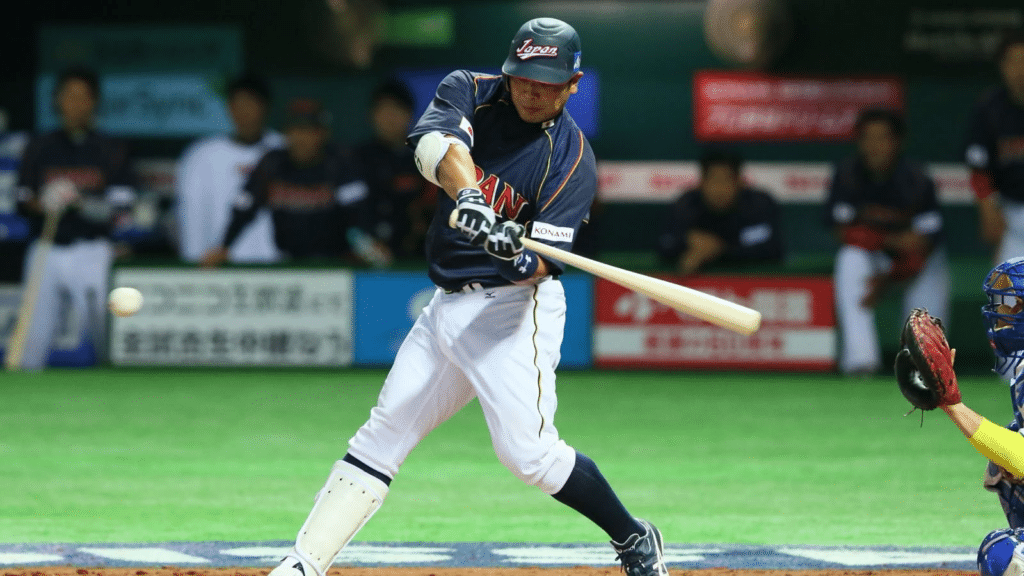
The power wasn’t limited to NPB seasons, either. As captain of Japan’s 2013 World Baseball Classic team, Abe hit two home runs in a single inning against the Netherlands, something that had never been done before or since.
Nomura referred to Abe as a “genius type” hitter, as someone who didn’t sit on pitches or read patterns so much as simply react to the ball in a way Nomura, ever the strategist, himself admitted he never fully understood but clearly respected.
Abe hit his 300th home run in April 2013 against the Hiroshima Carp, becoming just the third backstop in NPB history to reach the mark, once again behind Nomura and Tabuchi.
He hit his 350th a little more than two years after that, in July 2015.
Then on June 1, 2019, in what he’d already announced would be his final season, he hit a go-ahead solo shot at the Tokyo Dome for his 400th.
It made him the 19th player in NPB history to reach 400 home runs, and he currently sits 18th on the all-time list.
Among players who spent their careers primarily behind the plate, his total of 406 ranks third, behind only Nomura’s 657 and Tabuchi’s 474. In the entire history of Japanese baseball, there have been exactly two men better at it than Shinnosuke Abe.
Within his own storied franchise, his total trails only the legendary Sadaharu Oh’s 868 and Shigeo Nagashima’s 444.
Around ten days after his 400th, he took Lotte’s Yasuhiro Tanaka deep for his 229th different pitcher taken out of the park, an NPB record at the time.
He kept adding to the tally the rest of that season, finishing his career having gone deep against 233 different pitchers — a mark that still stands as the Central League record, even though Seibu’s Takeya Nakamura has since passed it to hold the all-time mark.
A Legacy Few Backstops Can Match
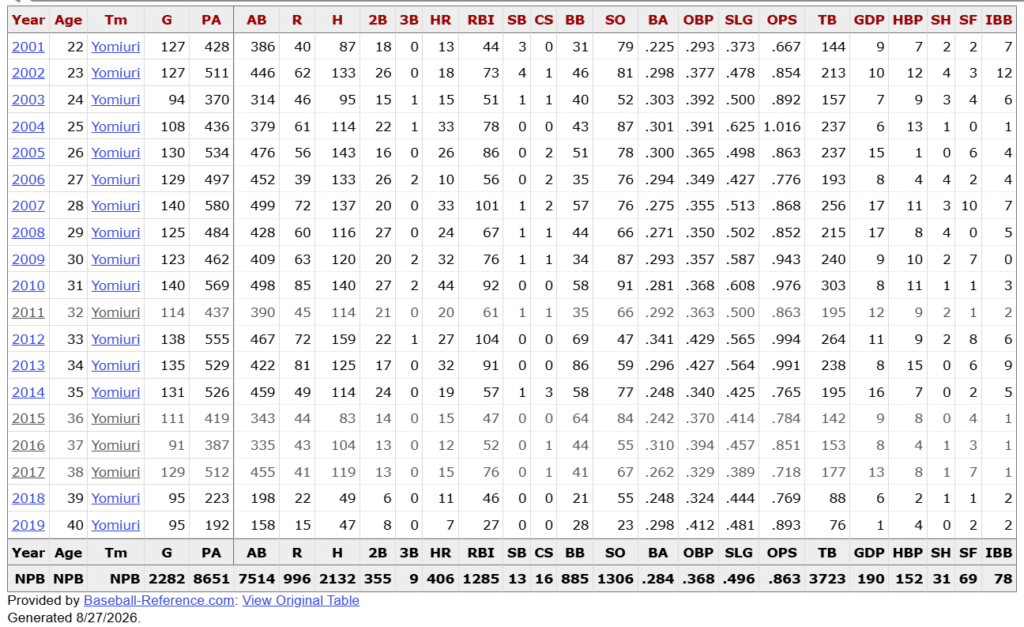
In the end, he won four Golden Gloves and one MVP and was named Best Nine catcher nine different times (tied with Furuta for the most in CL history). He made 13 All-Star Games and was named MVP for two of them.
He hit 60 home runs in interleague play, the most all-time. He also finished his career with 18 consecutive seasons of double-digit home runs starting from his rookie year, tied for third all-time.
He essentially never went a full season without hitting balls out of the park, for nearly two decades, no matter how banged up he was. And he was banged up a lot, since he was hit by the most pitches as a left-handed batter in history.
Let’s go back to the beginning. Only two names are on that list. Nomura and Abe. That’s the whole club, and it isn’t getting any bigger anytime soon.
