When it comes to power and home runs, 500 is the magic number in America. 28 different players have reached the milestone in major league history, from Eddie Murray to Harmon Killebrew to Barry Bonds. Eight players in Japan have reached the number, with Sadaharu Oh holding the world record at 868 round trippers.
In Japan, the magic home run number is 400. Professional baseball got a later start in Japan than in America, and schedules in NPB are shorter. Only 20 players have hit 400 or more in the history of Japanese baseball. Everybody knows Oh, but what about the players who sit behind him on the list?

It was 1997, and Norihiro Nakamura was a young slugger for the Kintetsu Buffaloes, three years into a career that would end with him as one of the greatest sluggers of his generation, though he did not yet know that. He reached first base against the Nippon-Ham Fighters, and standing on the bag, playing first, was Hiromitsu Ochiai — the man Nakamura idolized, whose swing he had studied so many times on VHS that the tape had worn thin. Nakamura asked him, the way a kid asks a legend for a scouting report: How did that at-bat look?
“Slow,” Ochiai said. One word. Nothing else.
Nakamura reached base again later in the game. He asked once again, and he got the same answer. Slow. He had no idea what it meant. It would be a few years before he understood that Ochiai meant he was starting his swing too late, that he should have been loading nearly all his weight onto his back foot the moment he set up rather than shifting his weight in time with the pitcher’s delivery.
There he was, a man who would hit 404 home runs in Nippon Professional Baseball, becoming one of only sixteen players in NPB history to reach both 400 home runs and 2,000 hits, spending years mulling over criticism he did not entirely understand from his batting idol.
A Slugger in the Making
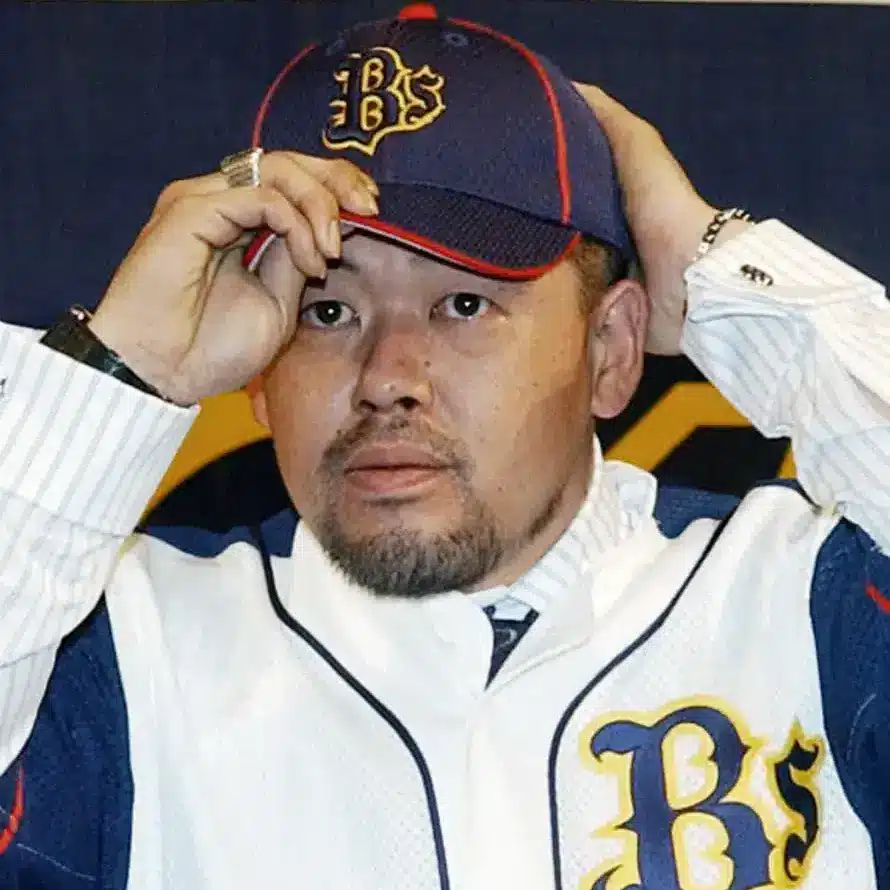
Nakamura’s swing was unconventional. He set up in a narrow stance, hands high, gripping an unusually long 88-centimeter, 900-gram bat as far down toward the knob as he could, pinky hooked underneath. Then he would kick his front leg up, almost absurdly high, dropping his hands to create one long beat of hesitation before he unloaded a full swing, every time.
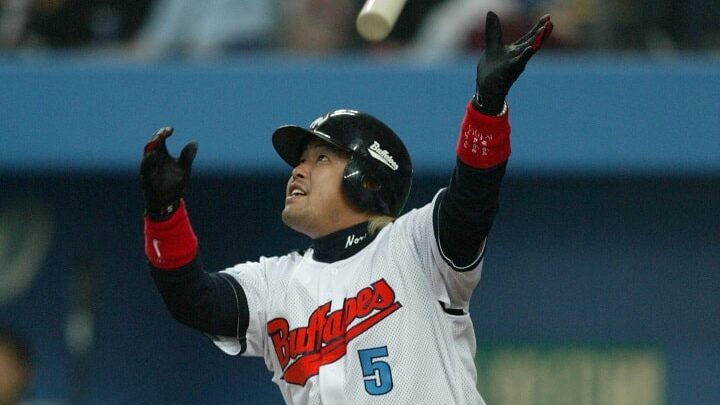
And when he connected, he had a habit that Japanese kids across the country were soon imitating in sandlots: he would fling the bat straight up into the air, high above his own head, and only then start his home run trot. He said later he’d borrowed the gesture from watching Kiyoshi Nakahata, a longtime Yomiuri Giants star. It didn’t really matter where he got it from because by the time Nakamura was finished, the bat flip was his.
He was born in Osaka, and like most boys, his parents bought him a plastic bat and ball for his second birthday. He started out hitting left-handed, imitating the swing of Hanshin’s Masayuki Kakefu, but a coach switched him to the right side, and when the ball started traveling further, the eight-year-old Nakamura decided that batting right-handed was simply more fun.
In the summer of his second year of high school for Osaka Shibuya, batting cleanup and pitching in relief, he hit home runs in back-to-back at-bats and then came on to hold the lead and secured Shibuya’s first trip to Koshien in eight years for an Osakan public school. Kintetsu’s area scout made note of the performance.
Kintetsu took him in the fourth round of the 1991 draft, the same round in which the Orix BlueWave took Ichiro, and the same draft in which Tomoaki Kanemoto (476 career home runs) went to Hiroshima and Daisuke Miura went to the Taiyo Whales (now Yokohama BayStars). It was a loaded draft.
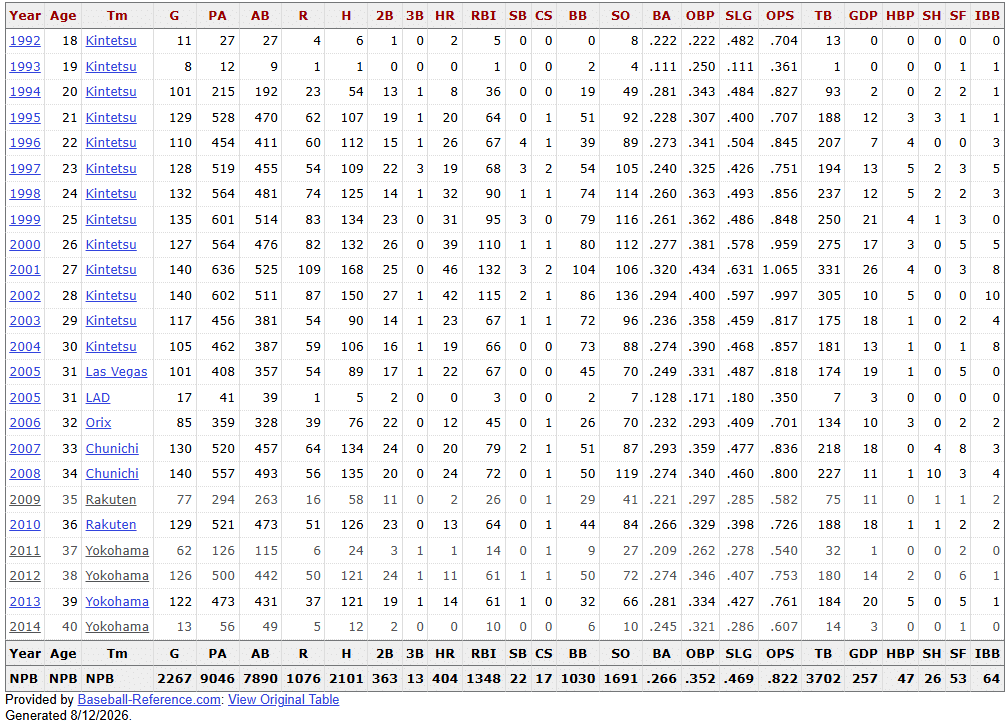
Nakamura spent his first two seasons receiving sporadic playing time (only eleven games in 1992, eight in 1993) before injuries opened the door in 1994. He even hit for the cycle that September, completing the feat with his first career triple (the first of only thirteen triples across 22 seasons). By the time 1995 came around, the third base job was his for good, though the early returns were modest: a slash line of .228/.307/.400 with 20 home runs and 92 strikeouts to go along with his first All-Star appearance.
The Heart of the Buffaloes
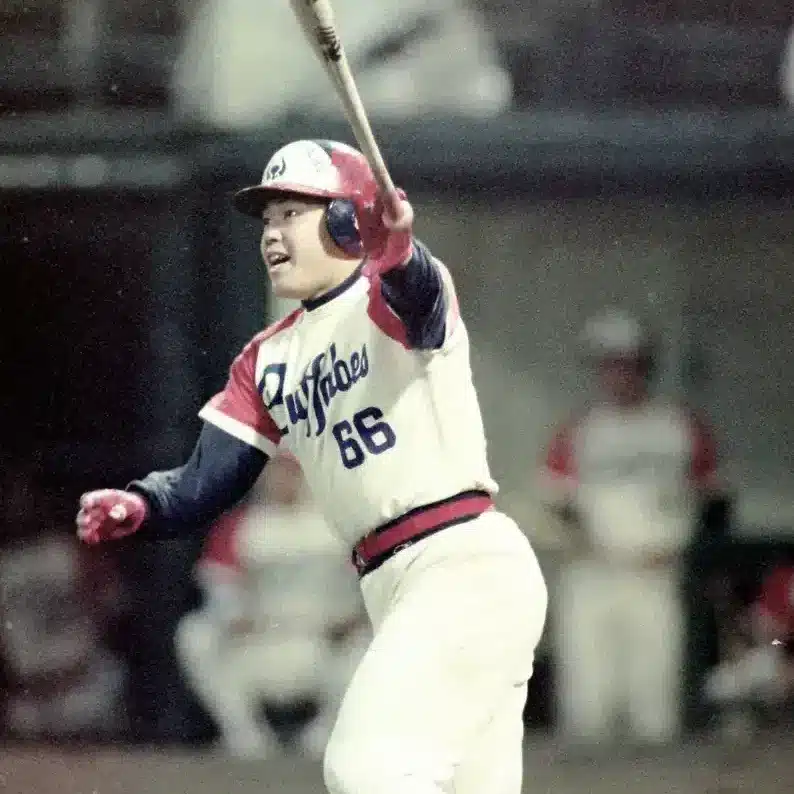
On September 16, 1998, Nakamura reached triple-digit home runs in a big way. The Pacific League that year was unusually close: the Lions, Fighters, Hawks, and Buffaloes were separated by a single game. Kintetsu had just dropped three straight to the Hawks and the Marines, but were still hanging in the pennant race. Down 3-2 in the bottom of the ninth, Nakamura came up as the fourth batter of the inning, having already gone hitless four times that day.
He didn’t waste his fifth at-bat. He hit a walk-off three-run homer for his 25th of the season, and the 100th overall for his career. Kintetsu would eventually finish fifth, five games back, undone by a five-game losing streak at the end of the month (that’s a lot of 5s). But that swing, with the season on the line, was Nakamura in a nutshell. He was the guy who wanted the bat in big spots, and who was physically incapable of taking anything less than his best cut when they came up.
His peak arrived alongside another slugger named Tuffy Rhodes, and together they built one of the greatest one-two punches in baseball history. In 2001, Rhodes hit 55 home runs — a Pacific League record — while chasing Sadaharu Oh’s single-season mark all year while opposing teams pitched around him. Nakamura publicly called out the strategy as cowardly and unfair to a teammate that he respected. And batting behind him, he hit 46 of his own. Together they combined for 101 home runs, more than even the fabled Oh-Nagashima tandem had ever managed in Yomiuri’s golden age.
Nakamura also hit .320, the best average of his career, and led the league with a .434 on-base percentage. He drove in 132 runs, one year after winning the double crown with 39 homers and 110 RBI in 2000, giving him his second straight RBI title. The two helped lead Kintetsu to their first pennant in twelve years.
The season also saw the single most important at-bat in Nakamura’s career: a walk-off, come-from-behind, two-run home run off Daisuke Matsuzaka on September 24. The young Seibu ace was the only pitcher he genuinely looked forward to facing. Whether he got on base or made an out, he’d walk off the field already wondering when they’d get to do battle all over again. According to Nakamura, that night was the one time the outcome actually mattered to him.
From Rock Bottom to Japan Series MVP
Then the baseball gods began to throw him curveballs he couldn’t quite handle. An agreement with the New York Mets collapsed in December 2002 after details leaked on the Mets’ website before Nakamura had even told Kintetsu officials. He backed out after saying he couldn’t trust the Mets and stayed in Osaka instead, signing a contract extension that made him the highest-paid Japanese player in the Pacific League.
Unfortunately, his knee gave out in 2003, ending a streak of 694 consecutive games. Then Kintetsu, the only organization he’d ever really known, merged with Orix after 2004 to become the Orix Buffaloes. He walked away from a huge contract, partly in protest of the merger, and finally got his shot at the majors in 2005 with the Dodgers.
It went about as badly as it could have: only 39 major-league at-bats, a .128 average and zero home runs before eventually being released at the end of the season. He returned to Orix in 2006 at the personal request of Akira Ohgi, the manager who’d been at the helm when Nakamura was drafted. Ohgi tragically passed away before the season started.
Nakamura hit a meager .232 while only eking out 12 home runs in 85 games. By January 2007, he was a 33-year-old free agent nobody wanted, running solo workouts in an empty stadium in what he called a fake training camp.
Chunichi’s Hiromitsu Ochiai — the same Ochiai from the “slow” story a decade earlier and now managing the Dragons — gave him a tryout on a friend’s recommendation. Nakamura shaved his head and took a 98 percent pay cut from his Kintetsu peak, wearing uniform number 205 because that’s what developmental players in the Dragons organization wore.
By the end of spring training, he’d earned his way onto the active roster and into uniform number 99. He rewarded Ochiai with 20 home runs and a .293/.359/.477 line in 130 games. That October, playing through back spasms, he hit .444 with four RBI in the Japan Series as Chunichi won its first championship in 53 years, and he was named Series MVP. He cried during the postgame interview while expressing his gratitude to the Dragons organization and its fans.
Nakamura was also more than just a power hitter as he’d go on to win Golden Gloves in both 2007 and 2008 — the latter his seventh and final one, tying him for second all-time at third base.
Forever Active
The end of his career is familiar for anyone who knows baseball. It ended in veteran journeyman style. He signed with Rakuten (the team created after the loss of Kintetsu) but was mostly ineffective due to age and injuries. Nakamura made headlines when he signed with the Yokohama BayStars towards the end of May in 2011. His BayStars tenure saw him start back on the bench, but he would soon take up a starting position.
In 2013, at 39, he became the fourth Japanese player ever to reach 2,000 combined NPB/MLB hits, and he deliberately declined any ceremony for it, because he wanted the real ceremony to be for his 2,000th hit in Japan alone, without the five lousy hits in Dodger blue attached. He got that one four days later, a double off his old team, fittingly, at Nagoya Dome.
And on June 30, 2013, in the second inning of a game against Chunichi at Yokohama Stadium, he hit a solo shot to left for his 400th career home run, becoming the 18th player in NPB history to reach that plateau. In true Nakamura fashion, he walked it off with a base hit later that same night.
In another move that is all Nakamura, it turns out that he never filed retirement papers. When Yokohama released him after the 2014 season (in which he went homerless in Japan for the first time since 1993), he refused a retirement ceremony and said that he intended to remain “forever active.” None of the 12 teams ever ended up calling, and he eventually turned to coaching.
He finished his career with 404 home runs, 1,348 RBI, 2,101 hits, seven Gold Gloves, and a place in a club — 400 homers with 2,000 hits — that only fifteen other players in the nation’s history have ever joined. He hit 14 grand slams and 10 walk-off home runs, both third all-time. He tied a record by walking five times in one game, and once homered for five games in a row.
And yet, he said more than once that he actually disliked hitting. His true baseball love was playing defense and taking ground balls at third. He supposedly had a knack for scooping balls backhanded and for fielding irregular bounces. It’s funny because it is kind of the opposite of everything he’s remembered for. Yes, he was a powerful slugger, but power was not all that there was to him. Nakamura just moved a little differently than everyone expected — Ochiai told him he was slow. But he wasn’t slow, he was just doing things at his own pace.
