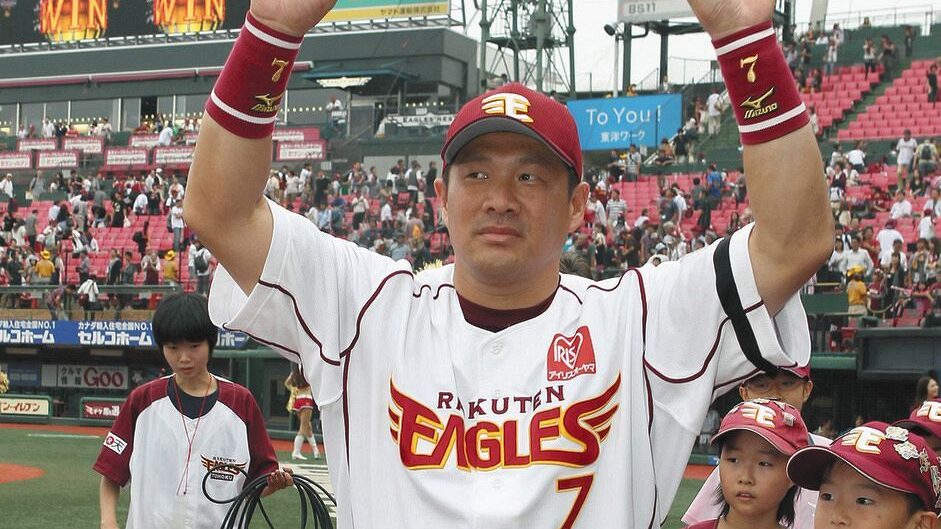
When it comes to power and home runs, 500 is the magic number in America. 28 different players have reached the milestone in major league history, from Eddie Murray to Harmon Killebrew to Barry Bonds. Eight players in Japan have reached the number, with Sadaharu Oh holding the world record at 868 round trippers.
In Japan, the magic home run number is 400. Professional baseball got a later start in Japan than in America, and schedules in NPB are shorter. Only 20 players have hit 400 or more in the history of Japanese baseball. Everybody knows Oh, but what about the players who sit behind him on the list?

The Takeshi Net
There is a net in Kasugai, Japan, twenty-five meters high, running along the left-center-field fence of the baseball ground at Aichi Institute of Technology Meiden High School. It has a nickname. They call it the Takeshi Net.
It was built, as best I can tell, sometime around 1985, for the same reason a city puts up a guardrail after enough cars go off the same curve: a problem kept repeating itself, and someone in charge finally got tired of it. The ground sits along the Shonai River, and beyond the left field fence runs a levee road, and on that levee road, with some regularity, cars were getting hit by baseballs. Not stray foul balls. Home runs.
Batting practice home runs, off the bat of a teenage catcher named Takeshi Yamasaki, launched with enough force to clear the fence, clear the open space beyond it, and find a moving vehicle on a public road. Eventually the school called the river authority. The river authority and the school agreed that this needed to stop, or at least be contained, and so they built a wall of netting tall enough to keep a growing boy’s home runs inside the schoolyard.
Let that sink in. We are talking about a human being who hit baseballs so hard and so often that a municipality had no choice but to intervene.
This is the first entry in a countdown of the twenty players who have hit 400 or more home runs in Nippon Professional Baseball history, and we begin, as countdowns do, at the bottom: Takeshi Yamasaki and 403 home runs. When he retired in 2013, he was 17th on the list but has since been passed and now sits at number 20. That’s the fate of every leaderboard and, in a sense, the fate of every life in baseball.
But let’s not get ahead of the net.
The Team He Never Wanted
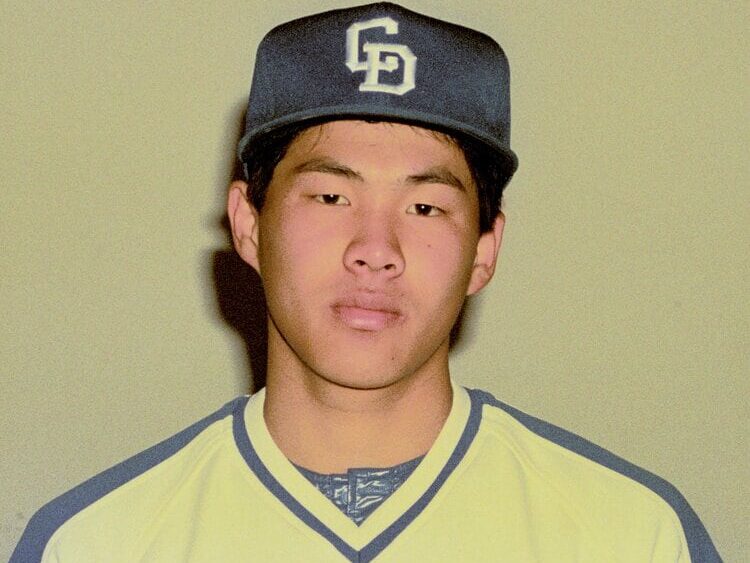
Yamasaki was born in Tokai City, Aichi Prefecture, in 1968, and raised a few kilometers over in Chita City, the third of three children to a father who worked for Nippon Steel and rooted, against the entire surrounding neighborhood’s wishes, for the Yomiuri Giants rather than the hometown Chunichi Dragons. Yamasaki grew up pulling for the Giants too, partly out of family loyalty and partly, he’d say later, because he hated doing what everyone else did. He wanted, quite specifically, to grow up and play for the team he idolized. Twice, in two different cruel little ways, that wouldn’t happen, and both times the Dragons — the hometown team he did not want — would be standing there instead with their arms wide open.
The first time was the 1986 draft. Yamasaki had become the best high school catcher in the country by reputation, with a powerful throwing arm and immense back strength. A Giants scout personally told him not to even talk to other teams. On draft day, the Giants lost a three-way lottery for their actual top target and spent their consolation picks elsewhere; they never called Yamasaki’s name. Chunichi did, with its second pick, largely because their new manager, the fiery Senichi Hoshino, had scouted the high school in person that spring and came away convinced.
Yamasaki, humiliated by Yomiuri, briefly considered refusing to sign and re-entering the draft in three years. What talked him out of it was almost embarrassingly simple: his own coach told him there was no sense delaying a pro career just to spite a team that had already slighted him, and a fellow draftee chided him at the introductory press conference — “you’ve got it easy, don’t you, getting to be a Dragon” — in a way that struck a nerve. He signed, took uniform number 22 (assigned personally by Hoshino, who wanted him to grow into a hitter like Koichi Tabuchi, twelfth all-time in home runs), and declared that his new goal was to hit home runs like teammate-to-be Hiromitsu Ochiai (sixth all-time), who arrived in a trade that same December.
The “Spring Man”
If you’re picturing a smooth rise from can’t-miss prospect to 400-home-run legend, I’m going to have to stop you because Yamasaki’s twenties were a case study in exactly how much raw power a body can have and still not know where home plate is on a given Tuesday. He roomed with his idol Ochiai at his first camp and came away with a complicated verdict: a brilliant hitter, and someone who showed no interest whatsoever in mentoring a rookie.
He didn’t appear in a single NPB game his first year — he was shipped to instructional ball in Arizona, then a Dodgers rookie affiliate, then home to serve as the backup to an established catcher, a role he grew to resent because it kept his actual selling point, his bat, out of the lineup.
The nadir came on October 15, 1989: a start behind the plate against Hiroshima that produced six runs allowed in two innings, five stolen bases surrendered (tying an NPB record), two errant throws, and a mid-game benching. Hoshino tore into him afterward — “what have you been doing for three years?” — and the front office effectively branded him unfit to catch. It was one of the worst days a young player can have, and also the day his long-delayed move to the outfield was finally decided.
He spent the next several seasons bouncing between Nagoya and the farm team, breaking bones with a regularity that felt like a pattern rather than mere tough luck. Through 1994, his age-25 season, his career line stood at .241 with 11 home runs in 206 games. He earned the dubious nickname “Spring Man,” or, more cuttingly, “the man who only hits in exhibition games.”
The Breakthrough and Its Blemish
Two developments helped turn his career around, and Yamasaki has always connected them: he got married in December 1994, and his manager later gave him an ultimatum about his weight. Hoshino, back for a second stint in 1996, looked at his 27-year-old slugger carrying something like 110 kilograms (242 lbs) and told him, essentially, lose the weight or don’t bother showing up to camp. Yamasaki dropped 22 kilograms in two months by spending hours in the sauna and living on the low-oil meals his new wife cooked. The effect showed up immediately: he could finally get his bat around on inside pitches, the specific mechanical thing that had been missing his whole career.
1996 was, by an enormous margin, the best year he’d had, and it produced one of the strangest storylines of the decade. He hit .322 with 39 home runs and 107 RBI, flirting with a triple crown into late July before fading to just the one crown — a crown that came with a blemish that had nothing to do with him. On the final day of the season, with Giants rookie Hideki Matsui sitting one home run behind him, Chunichi’s battery walked Matsui four straight times to protect the title.
Fans booed the battery mercilessly and also booed Yamasaki, standing out in left field, for a decision in which he had played no part; the whole finish drew uncomfortable comparisons to 1985, when Yomiuri itself had pitched around Randy Bass to protect Sadaharu Oh’s single-season record. Yamasaki, afterward, said it left him feeling deflated rather than triumphant.
He finished with 39 home runs, 24 of them at Nagoya Stadium, a split lopsided enough that any modern analyst would flag it in seconds.
There was also a fistfight that May, when Giants import Balvino Galvez buzzed his head and Yamasaki charged the mound*; he never regretted it, and would carry a version of that same temper through two more incidents with foreign players into his Rakuten years.
The game was suspended for more than 30 minutes to sort out all the chaos.
Twice Pushed Out

What followed the title was not stardom, but eleven years of being pretty good, sometimes very good, occasionally hurt, occasionally furious, and twice run out of a city he’d have preferred to stay in. Chunichi’s move into the cavernous Nagoya Dome in 1997 wrecked his numbers overnight.
A strange, deflating finish to 1999 saw him hit a pennant-clinching walk-off homer, scream something unprintable at Hoshino as he rounded first, and then break his wrist days later and miss the Japan Series entirely. He turned down more lucrative free-agent offers to stay loyal to Chunichi in 2001, only to be traded away the following year after a disastrous season.
Things went even worse with Orix: in April 2004, a manager broke a promise to start him in a game he’d invited relatives to, and Yamasaki responded by throwing his bat into the manager’s office and going home before first pitch. Orix released him that October.
He was thirty-five, out of work, and by his own account seriously considering retirement until his agent and his old high school idol talked him out of it, and a brand-new expansion team, the Tohoku Rakuten Golden Eagles, came calling with more enthusiasm than anyone in Nagoya or Osaka had shown him in years.
Reborn in Sendai

Here is something you’d never guess from the leaderboard: the best baseball of Yamasaki’s career happened when he was an old man in baseball years. He led his league in home runs and RBI at thirty-eight, made an All-Star team at forty-two, and hit his 400th career home run three months after that. Two men get most of the credit, in his own telling, and neither of them is someone you’d expect.
The first is Yasushi Tao, Rakuten’s inaugural manager*, who discovered his new cleanup hitter, in his 19th professional year, didn’t actually know the basic fundamentals of a right-handed swing, and rebuilt his mechanics from scratch. The hardest part wasn’t the mechanics — it was the pride. “He completely dismantled my swing and told me to fix it from the ground up. I had to throw away everything: the home run title in Nagoya, all my past glory. Start from zero with no pride left. If it didn’t work after that, it was over.” It worked: Yamasaki hit 191 home runs over seven seasons with Rakuten, extending a career that had appeared destined to end in 2004.
In their first season, the Eagles went 38-97-1. It was the only managerial stint in Tao’s career. In his playing days, he led the league in hits three times as a member of the Dragons.
The second man is Katsuya Nomura (second overall, and the first to hit 400 and 500 home runs in Japan), who took over in 2006 and whom Yamasaki has described, without much hedging, as the manager who made him fall back in love with a game he’d spent his adult life feeling merely obligated to. Their start was rocky (“completely rejected” was Yamasaki’s phrase for their first conversation), but it turned into something close to a father-son relationship.
Nomura’s actual advice was blunt: strikeouts and hard-hit outs are both just outs, so stop fearing strikeouts and commit fully to the swing. Hoshino had spent a decade making Yamasaki afraid of striking out; Nomura undid that fear almost immediately. “I can never sleep with my feet pointed toward him,” Yamasaki said of Nomura*. “He’s my mentor for life, and my father figure too.” He’d later say he only genuinely enjoyed playing baseball for four years of his career — his four years under Nomura.
This is a Japanese idiom that I didn’t bother localizing because it sounds quaint in English. It expresses a deep sense of gratitude and indebtedness to someone.
2007 is the number this comeback hangs on: 43 home runs, 108 RBI, both league-leading, at age thirty-eight, eleven years after his first home run title. It made him one of only three players in NPB history — with Ochiai and Tuffy Rhodes — to win a home run crown in both the Central and Pacific Leagues.
Four Hundred

On August 18, 2011, Yamasaki hit his 400th career home run off a young Yusei Kikuchi, becoming the 17th player in NPB history to reach the mark. That season, he also served as Rakuten’s cleanup hitter in the aftermath of the Great East Japan Earthquake and visited shelters between games. He was released that winter anyway, went home to Chunichi for two ceremonial final seasons, and at forty-four years and six months set three separate Central League age records in a single three-week stretch in May 2013: oldest to hit a triple, oldest to hit a double, oldest to deliver a walk-off hit. He retired for good after that season.
As for finishing with 403 home runs without ever reaching 2,000 hits, he was characteristically unbothered: “It’s a little embarrassing, playing that long and never getting 2,000 hits. But I’m satisfied I got to hit half of them in the Central League and half in the Pacific.”
He talked, late in his career, about how deliberately he thought about contact. The ideal was to meet the ball out in front, arm fully extended — but those pitches only came a handful of times a season, so everything else was adjustment. Down the left field line, he consciously aimed for what he called a jammed sweet spot rather than full extension, because a fully extended pull shot down the line tends to hook foul.
Yamasaki was more than a big man relying on brute strength. He was a thoughtful craftsman who also happened to possess immense power.
Back to the Net
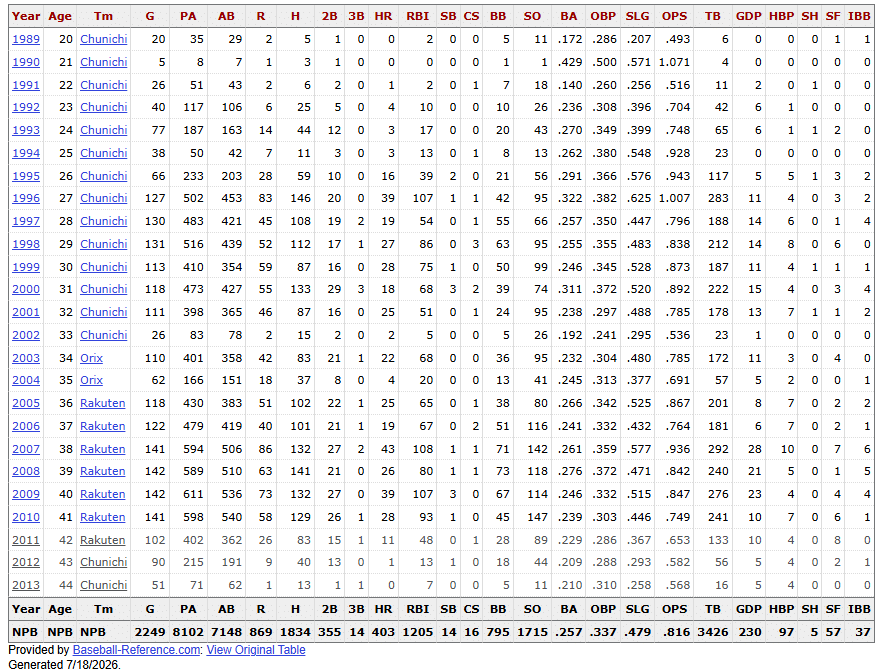
Twenty players in NPB history have hit 400 home runs. Yamasaki sits at the bottom of that list now, a number that will keep drifting as others come along and add to their own totals. But the bottom of a list of twenty isn’t nothing. He did it as a converted catcher nobody trusted defensively, as a “Spring Man” who couldn’t buy a hit for the better part of a decade, as a thirty-eight-year-old who found a level he’d never touched at twenty-five, and as a forty-two-year-old still chasing the ball into the seats.
Somewhere in Kasugai, I have to assume, that net is still standing.
