After a month of action in the 2026 Major League Baseball season, the Japanese contingent is pretty evenly split between those finding success and those trying to find their footing.
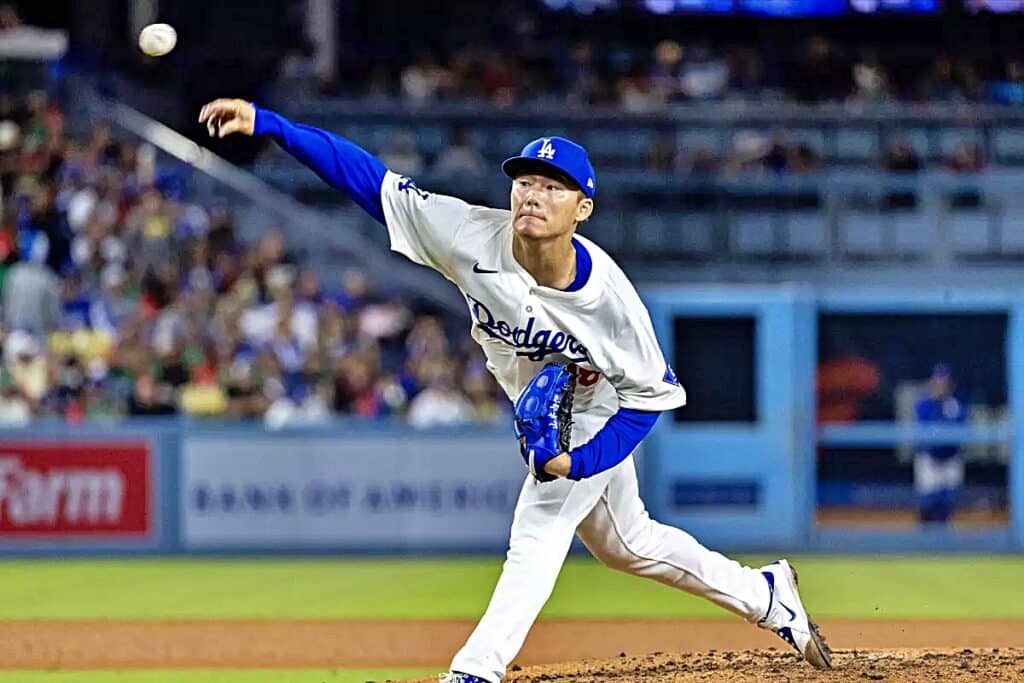
The Los Angeles Dodgers have the second-best record in MLB, and a lot of the credit goes to pitcher Yoshinobu Yamamoto and two-way star Shohei Ohtani.
Yamamoto was the Dodger pitching staff’s rock a year ago and has continued to be solid in the early stages of 2026. In six starts, he is 2-2 with a 2.87 ERA and a very low 1.01 WHIP. His strikeout rate is down a bit, at 7.6 per nine innings, compared to 10.4 per nine in 2025. However, his walk rate (2.2 per nine innings) is also down from 3.1 last year.
His first five starts were quality starts, and the last one – five hits and three earned runs in five innings against Miami – was far from a stinker.
To manager Dave Roberts, the ability to get past a bad inning is why Yamamoto has established himself as one of the best starting pitchers in MLB. “I think it shows why he’s the staff ace,” Roberts said. “I thought early on against San Francisco [April 21], he wasn’t sharp. For him to manage the pitch count, give up three runs [early] and then go seven innings and give us a chance to win the game, says a lot about him.”
As for Ohtani, the Dodgers are trying to strike a balance between his hitting and pitching workloads to keep him fresh and healthy. He has been limited to just being a pitcher in two of his last three starts.
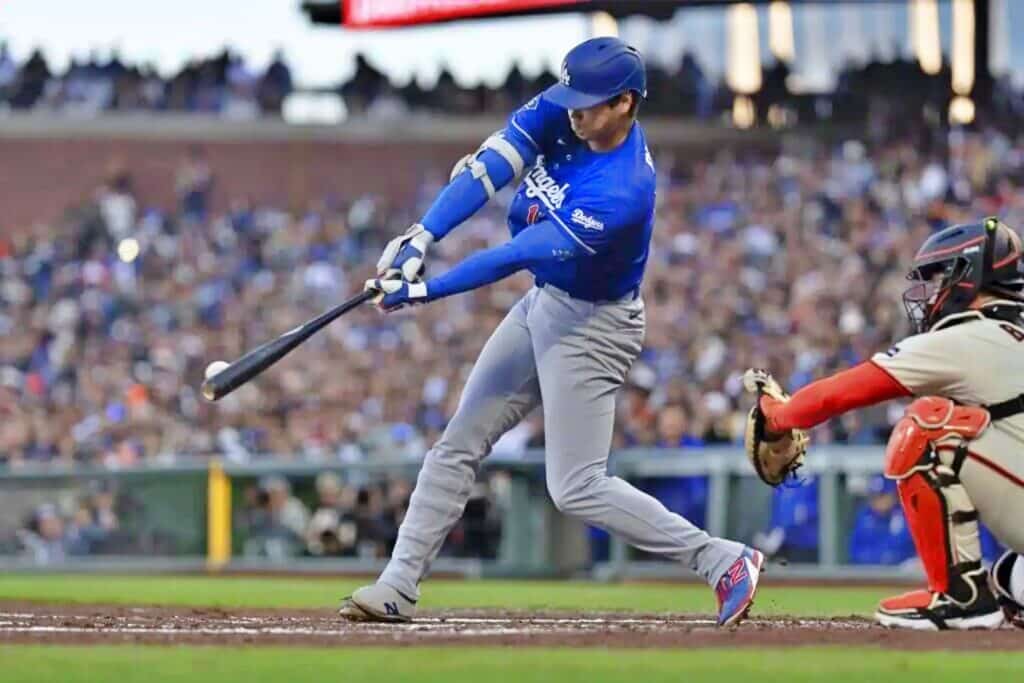
Photo: Stan Szeto / Imagn Images
“I’m always going to respect the decision regardless of whether I’m pitching or doing both,” Ohtani said. “I also understand the importance of getting to the end of the season with everybody healthy. So talking with the training staff, talking with the team, I think it’s really important that the team makes the decision on what’s good for the team.”
On the mound, he is 2-1 with a 0.60 earned-run mark and microscopic 0.87 WHIP. He has given up just 17 hits and nine walks in 30 innings. He’s gone six innings in all five of his outings, and all have been quality starts.
While Ohtani was a force on the mound, he’s not hitting on all cylinders at the plate. Still, he’s posted a slash line of .273/.406/.491, six home runs and 13 RBIs. He also established a 53-game on-base streak that began toward the end of last season and ended April 22 at San Francisco. That is the longest by a Japanese-born player in MLB – Ichiro Suzuki previously held the record at 43 – and tied him with Shawn Green for the longest by a Dodger since the team moved to Los Angeles in 1958. Duke Snider holds the franchise record at 58.
“It’s not horrible, but it is something I have experienced in the past, April being kind of like this,” Ohtani said of his offensive production.
Roberts said that “at times [as a hitter], there’s a little too much pull in there, and then I think he makes a concerted effort to stay on the ball, see it a little bit longer, and then gets beat a little bit with the fastball. When he stays in the middle of the field, there’s no one better.”
Over in the National League Central Division, the Chicago Cubs are near the top, and two key contributors have been pitcher Shota Imanaga and outfielder/designated hitter Seiya Suzuki.
Imanaga was an All-Star in 2024 but took a step back last season, in part due to a hamstring injury that reduced the strength in his lower half. He had a 3.73 ERA in 144.2 innings and also allowed 31 home runs – 20 in his final 12 outings.
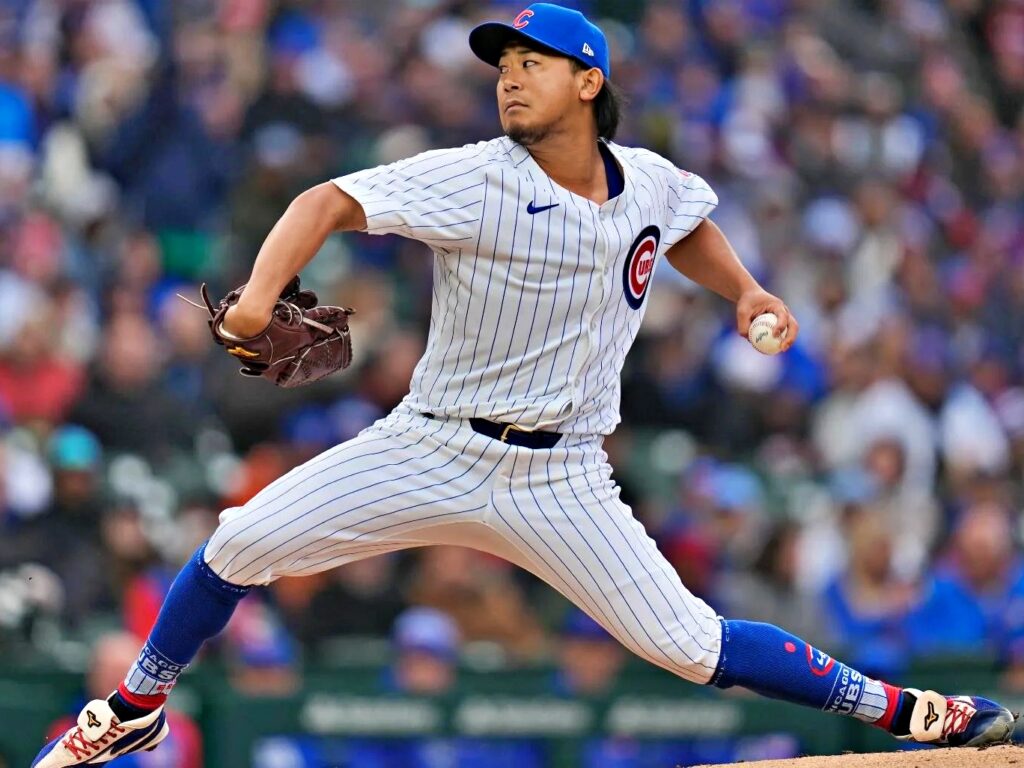
Photo: Erin Hooley, Associated Press
“He is going to respond to the things that happened at the end of the year,” Cubs manager Craig Counsell said. “He wasn’t happy [with] how he pitched.”
So far, Imanaga has responded positively. Four of his six starts have been quality ones, and he’s 2-2 with a 3.15 ERA and minuscule 0.87 WHIP. His average of walks per nine innings is 2.4, higher than last year’s 1.6, but his strikeout rate is also up to an average of 10 per 9 innings, compared to the 7.3 per nine of a year ago. Notably, he’s allowed an average of just 5.5 hits per nine innings, significantly lower than the 7.3 he posted in 2025.
Interestingly, Imanaga took a no-hitter through six innings and had struck out nine Pirates batters on April 10, but he was pulled after reaching 100 pitches in a game the Cubs eventually lost 2-0.
“That was the right decision,” Imanaga said via interpreter Edwin Stanberry.
Even more interestingly, Imanaga had pitched seven no-hit innings against the Pirates on Sept. 4, 2024, before letting relievers Nate Pearson and Porter Hodge finish up the 18th no-hitter in Cubs history.
Suzuki opened the season on the Injured List after suffering a minor sprain of the posterior cruciate ligament in his knee during a World Baseball Classic game. But he has been hitting well since being activated, posting a .328/.430/.567 slash line through April with five home runs and nine RBIs. He smashed those five home runs in seven games between April 21 and April 27.
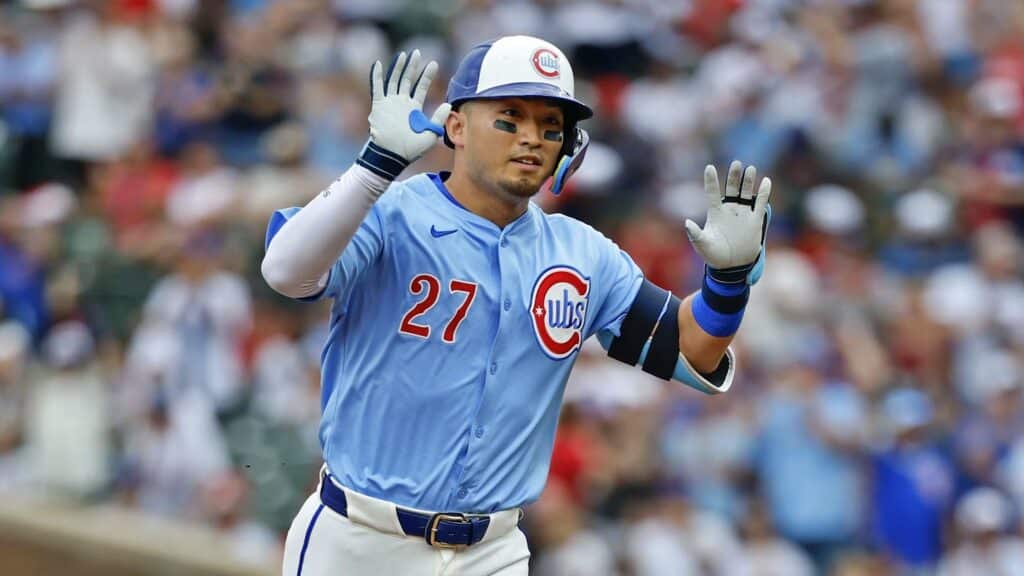
Early on, his walk rate is higher than last season’s, and his strikeout rate is slightly lower. If continued throughout the season, his .419 on-base percentage would be by far the highest of his MLB career.
“I’m still trying to figure things out,” Suzuki said. “It’s still just April. But I do have a good feel in the box now.”
He is beginning the final year of the five-year, $85 million contract he signed prior to the 2022 season. In his first four years, he has slashed .269/.346/.472 and averaged 22 home runs and 74 RBIs per season. In 2025, he achieved his first 30+ HR, 100+ RBI season (32/103).
Suzuki has said that he would be interested in a contract extension, though such talks have not yet taken place.
Two others who have shown well in the early going are Munetaka Murakami of the Chicago White Sox and Tomoyuki Sugano of the Colorado Rockies.
Murakami came to MLB at just 25, but with eight NPB seasons with the Yakult Swallows under his belt. In that time, he showed tremendous power with an average of 33 home runs per year and a good on-base percentage, but also a lot of swing-and-miss paired with below-average defense. How would that translate to MLB with its harder-throwing pitchers?
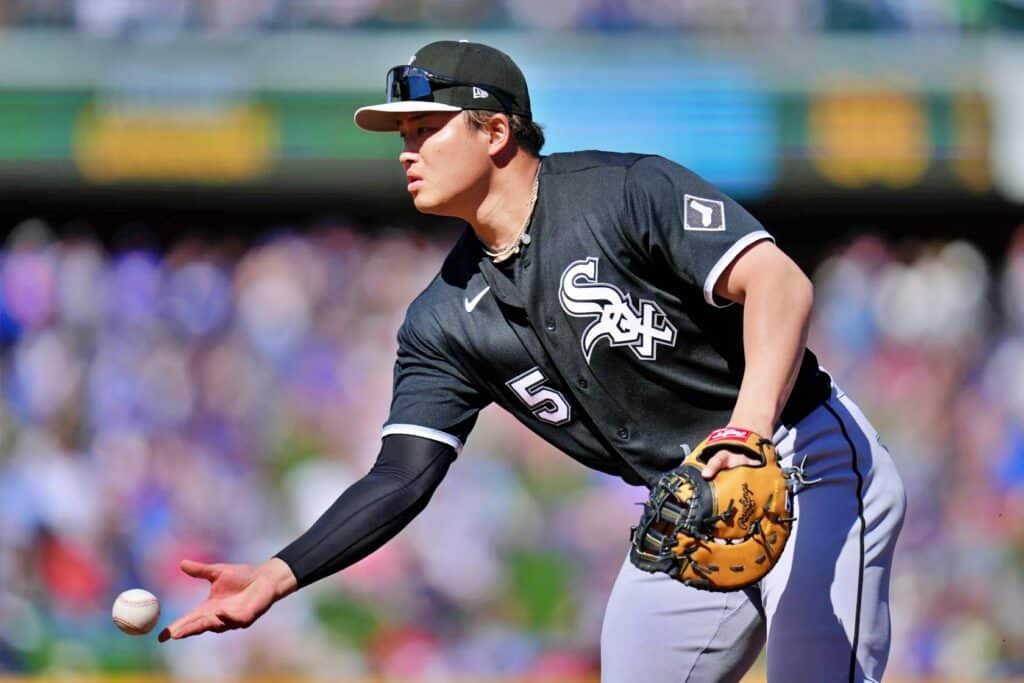
Well, so far – tremendous power, a good on-base percentage, a lot of swing and miss, and (slightly) below-average defense.
Murakami is tied for the MLB lead in home runs (12), is tied for second in the American League in strikeouts (32), and ranks second in the AL in walks (25). Baseball Reference has him at -0.2 bWAR defensively (at first base).
He has a .236/.375/.564 slash line. The on-base percentage isn’t far off the .390 mark he posted during his time in NPB, and the slugging percentage is higher than his NPB mark of .557. He has struck out in 41 per cent of his plate appearances – higher than the 31.3 mark in his NPB career – but is averaging one home run every 9.1 at-bats – at one point homering in five consecutive games. As an NPB player, he averaged a home run per 12.6 at-bats.
“It’s impressive. That one especially,” White Sox manager Will Venable said of Murakami’s homer against Washington on April 24. “We saw some balls hit that didn’t travel out that we thought were hit pretty well. Here he comes and kind of flips one out. It’s impressive the type of power he has.”
Sugano is a more under-the-radar type. A free agent after his first MLB season with Baltimore, he signed a one-year, $5.1 million agreement with Colorado in mid-February. The Rockies took a flyer on him in part because he walked an average of just 2.1 batters per nine innings in 2025. He also brings experience to a young staff, having pitched 12 seasons for Japan’s Yomiuri Giants, winning three league MVP awards and two Sawamura Awards – Japan’s equivalent of the Cy Young Award.
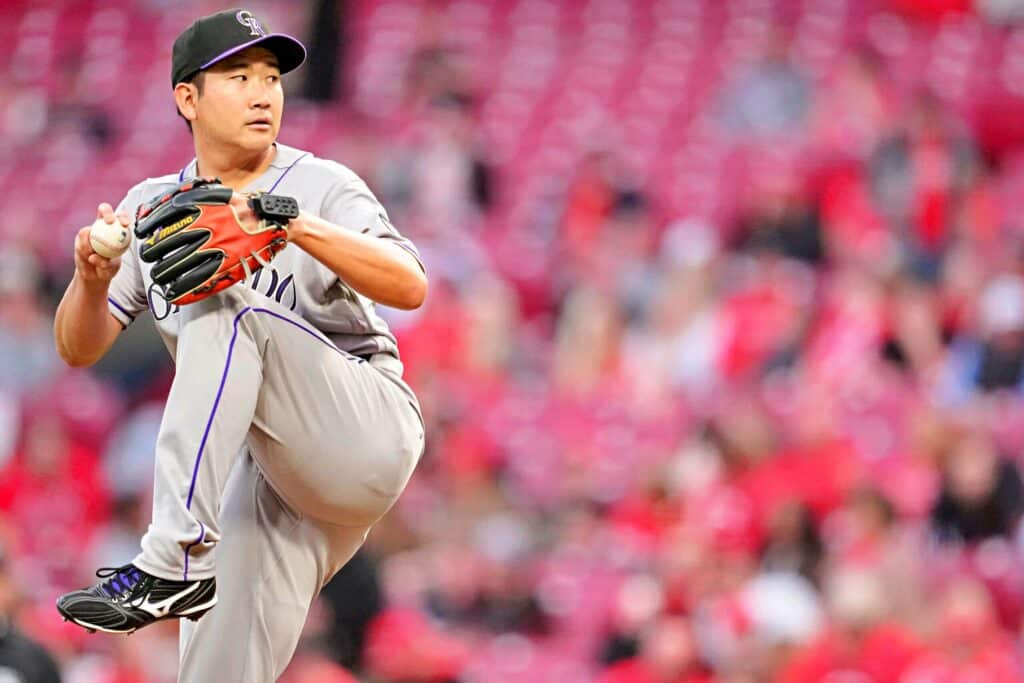
Photo: Associated Press
The early returns have been good, as he posted a 3-1 mark and 2.84 ERA in his first five starts. He was solid, except for a start against the Dodgers, when he allowed nine hits and five earned runs in four innings.
With the Orioles last season, Sugano gave up 33 home runs – an average of nearly almost two per game – which could be a red flag, given that he’ll be pitching half the time in Coors Field. Thus far, he’s given up five in 31.2 innings.
“The amount of home runs that I gave up, I want to decrease that,” Sugano said through an interpreter. “But, at the same time, I don’t want to be afraid to throw strikes, so I’m making sure I have the mentality of attacking hitters.”
Now to those still trying to find their way.
Dodger pitcher Roki Sasaki arrived in MLB last year as the No. 1 prospect in the game but was inconsistent and then spent four months on the Injured List. He returned late in the season and was very effective out of the bullpen.

Photo: IMAGN IMAGES via Reuters Connect
But the Dodgers still envisioned him as a starter, and that has not worked well so far in 2026. He is 1-2 with a 6.35 ERA and a bloated 1.81 WHIP. He has given up 28 hits and walked 13 batters in 22.2 innings. His walk rate is 5.2 per nine innings, and he has allowed an average of nearly three home runs per nine innings.
His only effective outing was his first, against Cleveland, when he allowed four hits and one run in four innings.
Sasaki’s velocity has increased, and he’s getting more swing-and-miss than when he was in the rotation last year, but he has had trouble getting deep into games. He is the only member of the rotation who has yet to record an out beyond the fifth inning.
But though he gave up four runs in five-plus innings in his last start against the Cubs, he showcased improved command and more emphasis on a new-look splitter.
“The first couple games, I couldn’t go deeper. It was kind of frustrating,” Sasaki said through interpreter Kensuke Okubo.
Pitcher Kodai Senga’s three MLB seasons have been a classic case of ups and downs, and 2026 has so far been a microcosm of that.
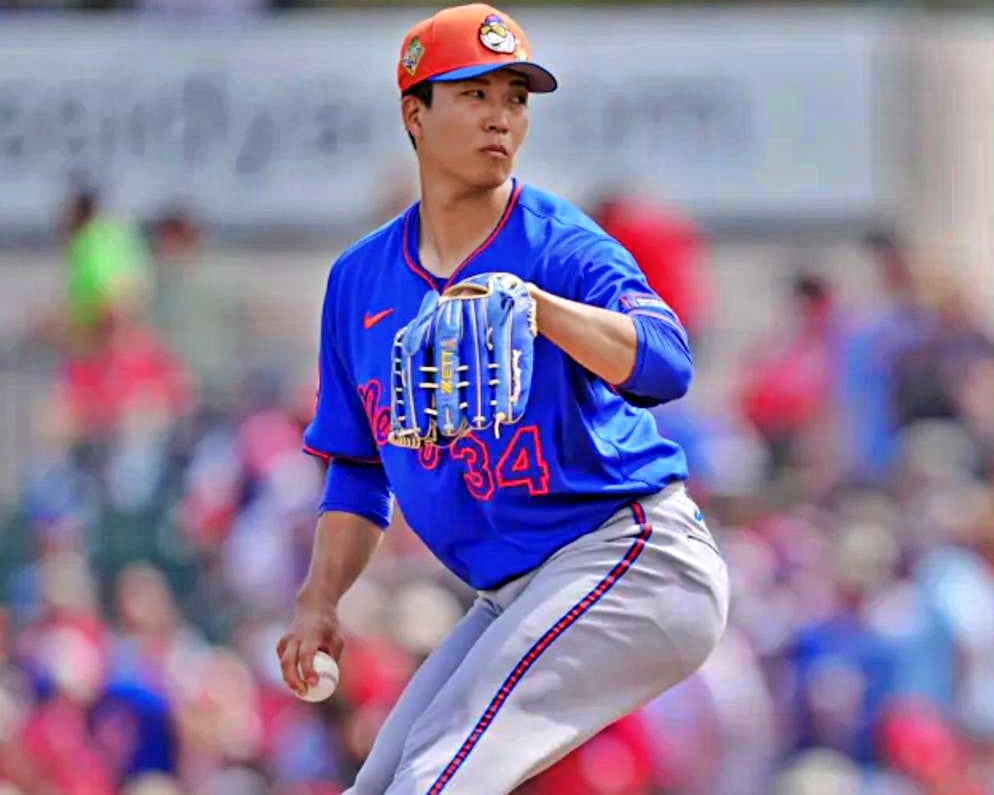
Following two seasons significantly impacted by injuries, Senga had a good spring and then effective starts against St. Louis and San Francisco to begin the season. One report noted that he had enhanced his arsenal with more velocity, three more inches of drop on his sweeper, more horizontal movement on his sinker, and increased usage of his sweeper and cutter.
But he regressed in his next three outings after that analysis was published, losing to the Athletics, Cubs, and Rockies while allowing 17 hits, eight walks, and 16 earned runs in 8.1 innings. He was 0-4 with a 9.00 ERA and 1.95 WHIP before going on the 15-day injured list on April 28 with what was termed lumbar spine inflammation between the L4 and L5 vertebrae in his lower back, which is also causing him right hip discomfort.
Senga said through an interpreter on April 26 that “I know that the performance out on the field isn’t something where I can be like, ‘Oh, I can be in the rotation.’ … I don’t know what’s going to happen.” He said his issues were mechanical, not mental – “I know what’s going on. I know why I’m not able to perform. I just need to…get back to a high-performing pitcher.”
Senga was 12-7 with a 2.98 earned-run mark in his rookie MLB season of 2023, but he has made just 28 starts since then. He still has a year and $15 million remaining on his contract after this season.
Pitcher Yusei Kikuchi of the Los Angeles Angels has been known for inconsistency through his seven MLB seasons, and 2025 swung the wrong way. Thus far in 2026, there has been no directional change.
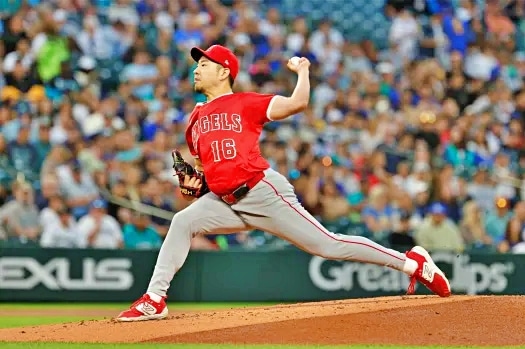
He was 0-3 with a 6.21 ERA and 1.59 WHIP in his first six starts before facing the White Sox on April 29. He pitched two scoreless innings in that game and then left after experiencing shoulder tightness. After the game, Kikuchi said he had started to feel the tightness in his previous start against Kansas City, and it worsened against the White Sox. He later went on the 15-day Injured List.
His only good performance in his first six games was against San Diego on April 18 when he pitched six scoreless innings, made only 86 pitches, gave up just four hits and a walk, and struck out eight batters.
In that game, his four-seamer averaged 96.4 mph, or 1.3 mph higher than his season average to that point. He also threw it 45 percent of the time, much more than his season average of 25 percent.
“I went over my mechanics this week and I think that brought me good results,” Kikuchi said through interpreter Koki Goto. “Going into this season, I raised my arm angle to become a better pitcher, but for the first four games, it didn’t work out well, so I brought back last year’s form. I tried to recall the drills I did, and I think that brought me good results.”
In his next start, against Kansas City, Kikuchi only gave up five hits over five innings. However, they all came in the fourth inning when the Royals scored five runs en route to a 6-3 victory.
Pitcher Tatsuya Imai signed a three-year, $54 million deal with Houston in the offseason after nine years with the NPB’s Seibu Lions, and he’s had a rough start in MLB. He gave up seven hits and 11 walks in 8.2 innings over three starts and posted a 7.27 ERA. Then he was placed on the Injured List on April 12 with arm fatigue.

He threw a bullpen at Daikin Park before the Astros’ series finale against the New York Yankees on April 26 and then had a rough rehab start with AA Corpus Christi on April 30. Imai threw 59 pitches across two innings – walking three batters, throwing a wild pitch, permitting six hits, and giving up five earned runs.
Imai, the first Japanese player the Astros have signed directly from NPB, has said that the transition to the United States had been tougher than expected, but Astros manager Joe Espada said he believes things are getting better.
“We continue to talk with him and encourage him to be open with us,” Espada said. “I know he’s got his strength coach finally here. He feels like he’s more complete when it comes to his progression and his process that he has leading into his next start, into his bullpen, so he’s in a much better place mentally.”
Third baseman Kazuma Okamoto is also transitioning to MLB this year after a long NPB career. He’s adjusted somewhat better than Imai, but is still a work in progress.
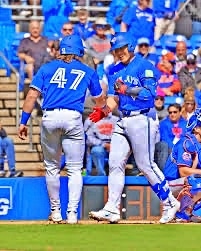
The 29-year-old long starred for the Yomiuri Giants, stringing together six consecutive seasons of 30-plus home runs with a peak of 41 in 2023. On paper, he brings an immediate offensive upgrade to the Blue Jays’ lineup, but that hasn’t really happened yet, despite some flashes. However, the Blue Jays knew all along that it would take time for Okamoto to acclimate to an entirely new situation.
He’s currently at .218 with a .301 on-base percentage and .373 slugging mark. He has five home runs and driven in 15 runs. He has struck out in 34.5 percent of his at-bats, far higher than the 20.2 percent mark during his NPB career.
The Blue Jays want to see Okamoto get back to “bigger moves and more aggressive moves,” as manager John Schneider put it. Okamoto is a strong, physical player who can generate much power when he really lets loose, but we haven’t seen that on every swing recently.”
“To be honest, I obviously want to hit more,” Okamoto said through interpreter Yusuke Oshima. “Over the long course of a season, I know there are going to be ups and downs, and that’s not different from playing in Japan. Hopefully, I can get it going soon.”
Masataka Yoshida, now in the fourth season of a five-year, $90 million contract with the Red Sox, is in an interesting spot.
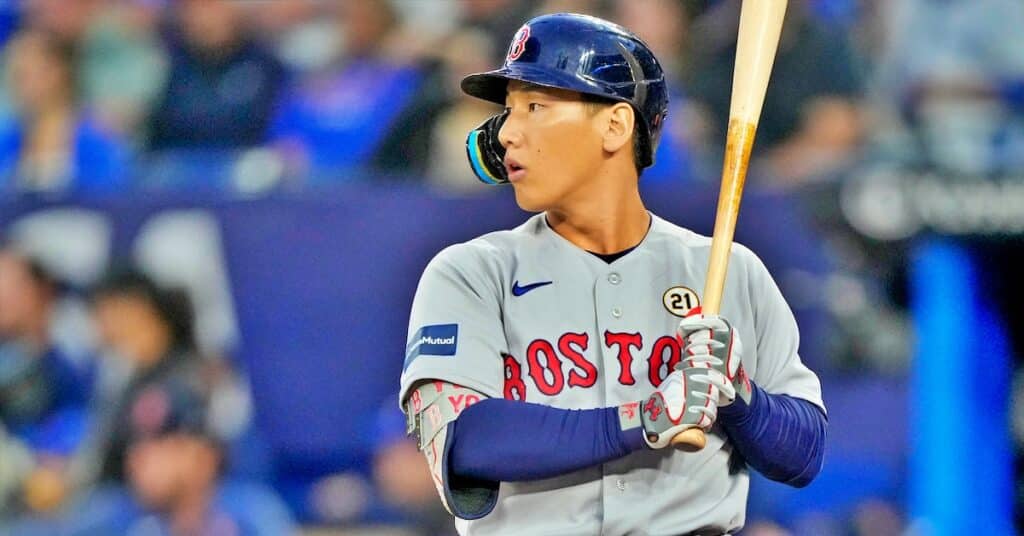
On the surface, he’s been decent – a .282/.337/.425 slash line in his first three seasons. But his power has never fully materialized – just 29 home runs – and his defensive liabilities have turned him into a full-time designated hitter. After returning from shoulder surgery in 2025, he appeared in 55 games and had a 0.2 bWAR – barely above replacement level.
Yoshida did finish the 2025 season strongly, and he posted a .295 average in April of this season, but he has no home runs and just five RBIs in 49 at-bats.
Boston has plenty of options for both the outfield and first base, though, so where Yoshida fits is unclear.
“There’s a challenge there, in that I don’t know when it’s going to be my time,” Yoshida said.
Another unknown is how Yoshida’s status might be affected by the recent firings of Boston manager Alex Cora and several members of his staff.
Relief pitcher Yuki Matsui began the season on the Injured List because of a left adductor/groin strain suffered during a live batting practice session in February. He has yet to play in a Padres game, though he is currently on a minor league rehab assignment and could be activated soon.
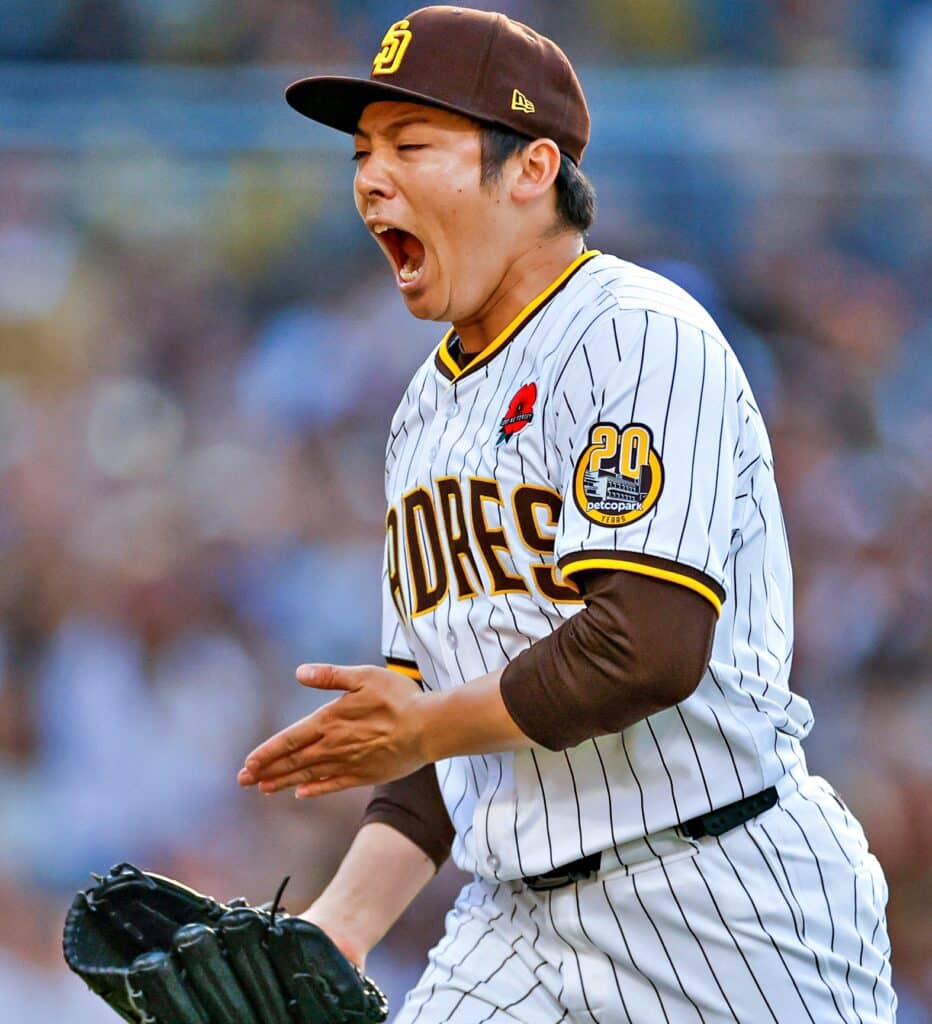
Photo: David Frerker-USA TODAY Sports
Matsui has two years remaining (plus a player option) on the original five-year contract he signed with San Diego. One report labeled him as “aggressively average” in his first two seasons – a 3.86 ERA, 3.52 xERA, and 4.40 FIP in 126.0 innings, all totaling up to exactly 0.0 fWAR.
It will be interesting to see how the Padres utilize Matsui when he returns, since the San Diego bullpen was dominant last year and has carried that over into the 2026 season. In 2025, the Padres’ bullpen ranked first in MLB in ERA (3.06) and saves (49) while finishing in the top three in strikeout rate (25.8%) and FIP (3.53).
NOTES: An interesting piece in The Athletic about how some Japanese imports have found it easier than others to adjust to playing in MLB and living in North America . . . Padres right-hander Yu Darvish is proceeding at his own pace in his rehab from Tommy John surgery, and he still isn’t sure if he’ll pitch again . . . Pitcher Kenta Maeda, who spent ten seasons in MLB with the Dodgers, Minnesota Twins, and Detroit Tigers, returned to NPB and is 0-1 with a 2.45 ERA in two appearances for the Rakuten Golden Eagles . . . Through 41 games for Stanford University this season, Rintaro Sasaki has slashed .261/.401/.580 with 14 home runs and 34 RBIs.