Photo: Chris Young/The Canadian Press/AP
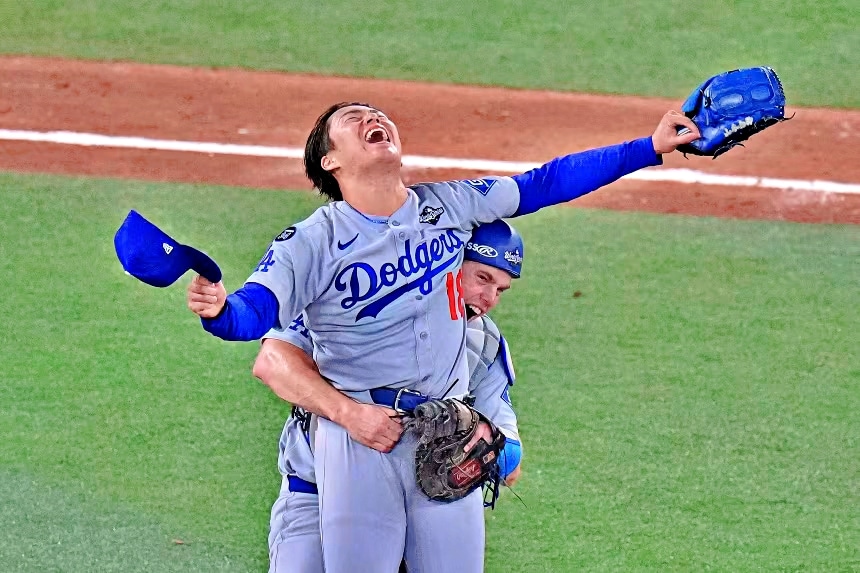
Eight Japanese import players dotted team rosters when the 2025 Major League Baseball postseason began. When the World Series ended late into the night of November 1 with the Los Angeles Dodgers’ thrilling Game 7 victory over Toronto, three were left standing and admiring the Commissioner’s Trophy.
Pitchers Yoshinobu Yamamoto and Roki Sasaki and two-way star Shohei Ohtani all made significant contributions to the Dodgers’ second straight championship, with Yamamoto making the biggest splash by earning the World Series Willie Mays Most Valuable Player award.
Yamamoto earned the award with an otherworldly performance. He went the distance in a Game 2 victory, giving up just four hits and one run while striking out eight batters. He came back in Game 6 with the Dodgers down three games to two and pitched six innings of one-run ball to help tie the Series. Then, a day later, he made 34 pitches in the final 2.2 innings – escaping a one-out, bases-loaded threat in the ninth – as the Dodgers took a 5-4 extra-inning win to claim their second straight title.
He was the first pitcher since Arizona’s Randy Johnson in 2001 to win three games in a single World Series, the first in a Series to have three victories in road games, and just the fourth pitcher to win both Game Six and Game Seven.
Also, he had been warming up in the bullpen and was ready to enter Game 3 when Freddie Freeman ended the game with a home run in the bottom of the 18th inning.
“It’s unheard of,” Dodgers manager Dave Roberts said, “and I think that there’s a mind component, there’s a delivery, which is a flawless delivery, and there’s just an unwavering will. I just haven’t seen it. I really haven’t. You know, all that combined. And there’s certain players that want moments and there’s certain players that want it for the right reasons. But Yoshi is a guy that I just completely implicitly trust, and he’s made me a pretty dang good manager.”
Yamamoto just finished the second season of a 12-year, $325 million contract, and he’s paid major dividends already.
Dodger pitching coach Mark Prior said, “He’s always looking to get better. He’s always looking to figure out a way to get hitters out, different ways. He can give you different looks with the same guy on the mound. He’s been as dominant as you’ve seen in a long time.”
Yamamoto was 5-1 in six playoff outings (five starts) with a 1.45 ERA and microscopic 0.78 WHIP over 37.1 innings. He struck out 33 batters and walked just six. The only even minor blip was his October 8 loss to Philadelphia in which he allowed six hits and three runs over four innings.
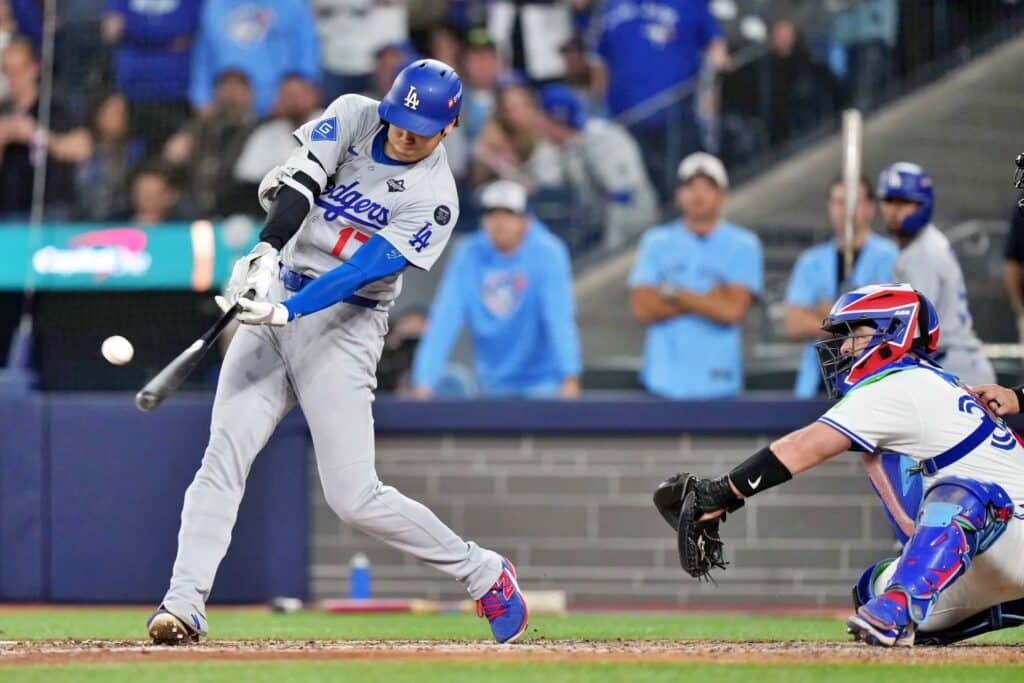
Ohtani, also in the second year of a long-term mega contract, wasn’t as dominant on the mound as he sometimes has been, but he had some big moments at the plate. He averaged .265 with eight home runs, 14 RBIs, and 16 bases on balls, along with a 1.096 OPS.
In the 18-inning Game 3 against Toronto, he hit two doubles and two home runs – the latter tying the game in the seventh inning – in his first four at bats. The Blue Jays then walked him in his next five plate appearances, four times intentionally.
On October 17, he hit three home runs and struck out 10 batters in six scoreless innings to power the Dodgers to a 5-1 win that clinched the National League title and sent them to the World Series. His first-inning home run made him the first pitcher in MLB history to hit a leadoff home run in either the regular season or the postseason, and it was also the first home run by any Dodgers pitcher in postseason history.
To that point, he had had just four hits in 33 at bats in the playoffs. One report said Ohtani had a “visible edge,” even taking batting practice on the field prior to the game, something he had not done at Dodger Stadium in his two seasons with the club.
That game was his only particularly effective playoff outing on the mound. In his other three starts – against Philadelphia, Milwaukee, and Toronto – he gave up 10 earned runs in 14.1 innings. In Game 4 against the Blue Jays, he allowed four earned runs – two on a homer by Vladimir Guerrero, Jr. – in six innings. In Game 7, he gave up five hits and three earned runs – all on a home run by Bo Bichette – in 2.1 innings.
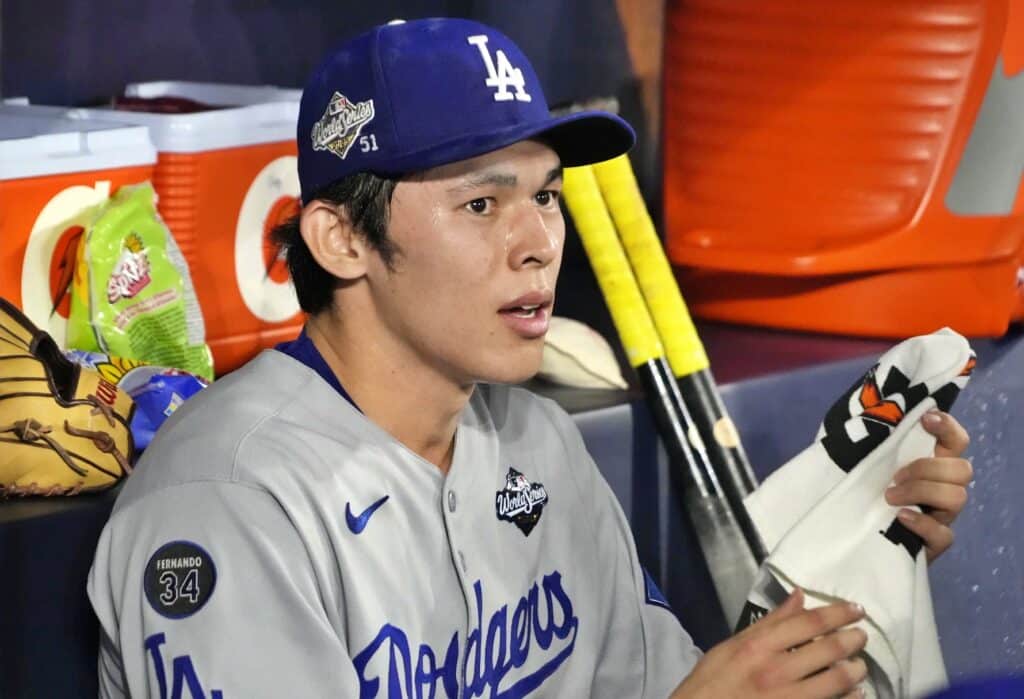
Photo:John E. Sokolowski-Imagn Images
Sasaki didn’t get as many of the headlines as Yamamoto and Ohtani, but he made a significant contribution after missing much of the regular season because of a shoulder impingement. He was activated during the last week of the regular season but was thrust into an unfamiliar role as a reliever.
The 23-year-old had endured the weight of extremely high expectations after coming to the Dodgers as a starting pitcher, so the move to the bullpen required “a little bit of a leap of faith,” according to Roberts.
And the faith was borne out, as Sasaki made nine appearances in the playoffs, including two in the World Series, and allowed just six hits and one run in 10.2 innings while earning three saves. He had a 1.03 WHIP.
“The guy at the end throwing 100 with a split? That shouldn’t be fair,” Brewers manager Pat Murphy joked of Sasaki during the team’s battle in the National League Championship Series. “We’re going to try to petition the league and see if we can get him suspended for something.”
In addition to the Dodgers’ three import players, five other imports appeared in the playoffs for their teams.
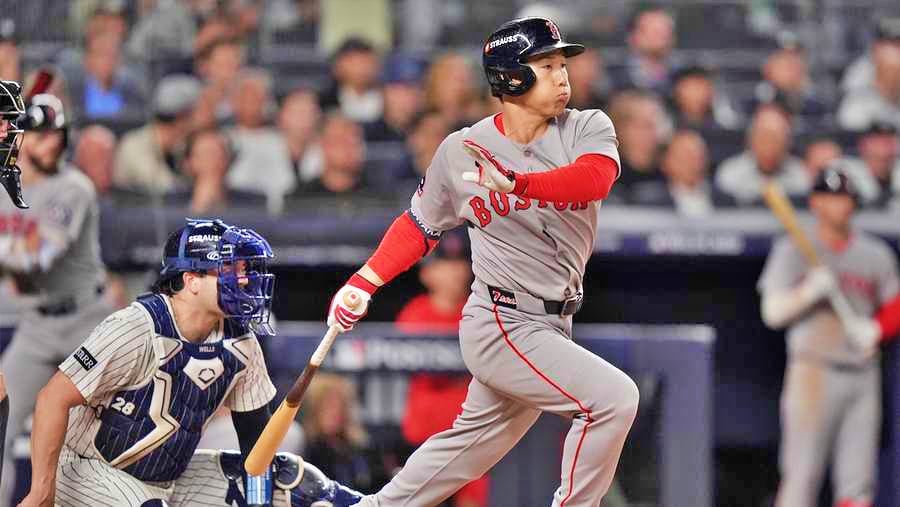
After struggling for much of the season, Masataka Yoshida came alive in the final month of the regular season and sustained that momentum in the American League Wild Card Series against the Yankees, though the Red Sox failed to advance. He had four hits in seven at bats in the three games, and his two-run single in the top of the seventh inning of the first game gave Boston the lead for good in an eventual 3-1 victory.
Yoshida had posted a .333/.351/.486 slash line in September with two home runs and 13 RBIs, and the Red Sox hope he can continue that sort of production in the final two seasons of his five-year, $90 million deal. To this point, he’s been somewhat of a disappointment, given the size of his contract.
In the Padres’ disappointing loss to the Cubs in the National League Wild Card Series, Yuki Matsui did not make an appearance, and Yu Darvish had a very short, ineffective outing in the deciding Game 3. Darvish got out of the first inning unscathed, but gave up two runs in the second without getting an out and was removed. Chicago went on to a 3-1 win and advanced to the NL Division Series.

That completed a season in which Darvish did not pitch until July because of injuries, and it was his second successive difficult season. He finished 5-5 with a 5.38 earned-run mark in the regular season and has three years remaining on the six-year, $108 million contract extension he signed in February 2023. San Diego needs him to regain at least some of the effectiveness he’s shown through most of his career.
The Cubs lost in the NLDS to the Brewers, and Shota Imanaga and Seiya Suzuki were not particularly effective.

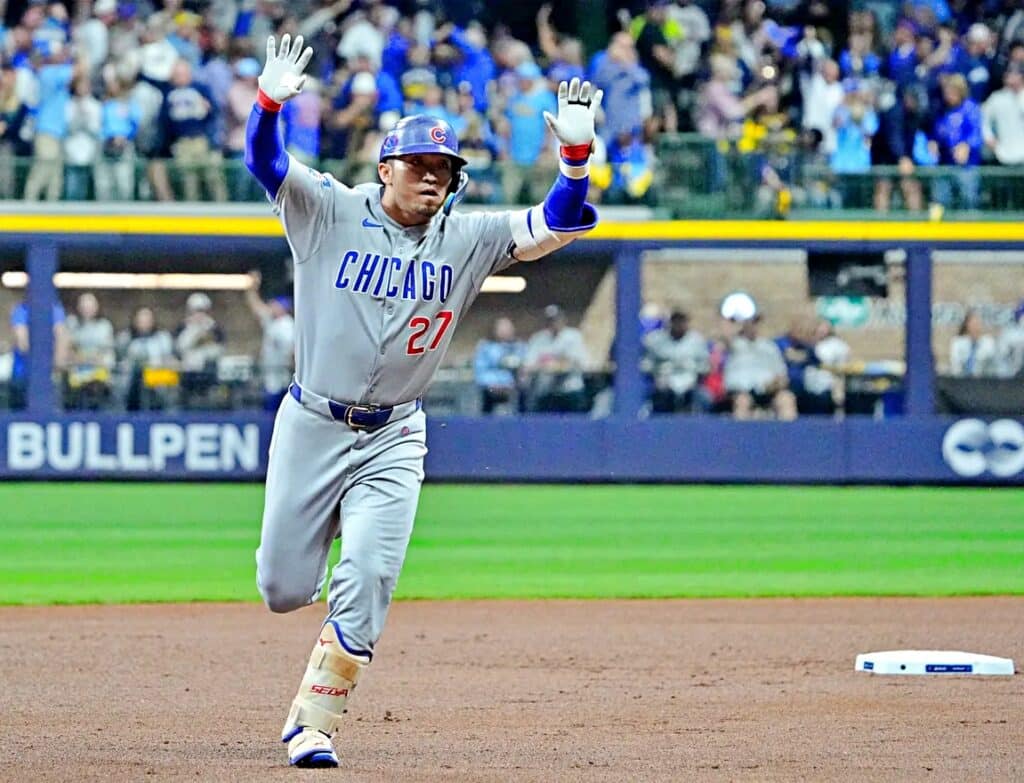
In two outings, one against San Diego and one versus Milwaukee, Imanaga allowed eight hits, six earned runs, and three home runs in 6.2 innings for an 8.10 earned-run average. That followed a September in which he went 1-2 with a 6.51 ERA and allowed 10 home runs in 27.2 innings.
Imanaga allowed a game-changing two-run homer to Manny Machado in Game 2 against the Padres, and he gave up 31 in 144.2 innings in the regular season. That included a dozen in his final six starts of the regular season, giving him a rate of 1.93 homers allowed per nine innings, the highest mark among MLB pitchers who pitched at least 140 innings.
Suzuki averaged just .226 (7-31) in eight playoff games with two home runs and four RBIs. He struck out 10 times, walked just once, and had a .250 on-base percentage.
NOTES: In the recent NPB draft, the SoftBank Hawks won the right to negotiate with Rintaro Sasaki, the Stanford University slugger who bypassed the NPB Draft out of high school in 2023 to go to the United States. Sasaki will play the upcoming season at Stanford and evaluate his standing in the 2026 MLB Draft before ultimately choosing to go pro with SoftBank or an MLB team. He has until the end of July 2026 to decide . . . Corner infielder Kazuma Okamoto of the Yomiuri Giants will be posted to MLB this off-season, according to a recent report. Okamoto has 248 home runs during his NPB career, with a high of 41 in ’23. Injuries limited him to 77 games in 2025, and he hit 15 homers with a .992 OPS. He’s a lifetime .277/.361/.521 hitter. One report said he “has terrific hand-eye coordination and solid contact skills to go along with the power,” while another questions his bat speed. Munetaka Murakami of the Yakult Swallows is another. Murakami, who will be 26 in February, has hit 245 home runs in the past eight seasons, including 56 in 2022, but he was limited by injury to just 56 games with the big club in 2025 and hit just 22 homers. He is said to not be a good defender at either third base and first base. A third possibility is right-handed pitcher Tatsuya Imai of the Seibu Lions. One ranking said Imai “profiles in MLB as a mid-rotation innings-eater who can keep hitters guessing.”